California IEP Evaluation Timeline, Dispute Routes and Parent Resources (2026)
- Evaluation window
- 60 days
- The clock starts at
- Written parental consent
- State complaint deadline
- One year
- Due process deadline
- Two years
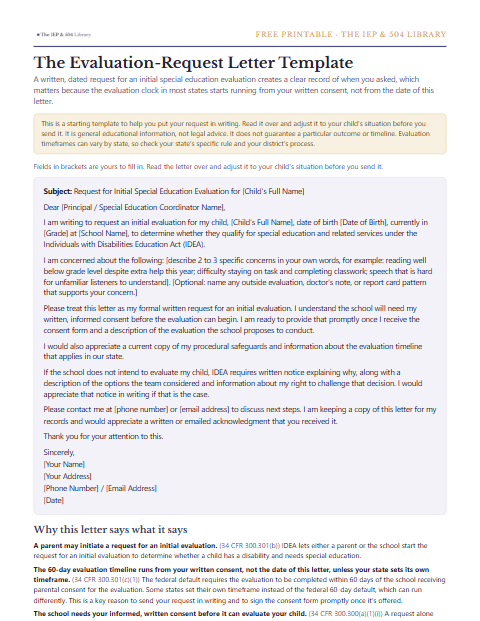
How long does a school in California have to complete an IEP evaluation?
A California school district has 60 days from the day it receives a parent's written consent to finish the assessment and hold the IEP meeting, so the state clock runs all the way to a written plan rather than stopping at the testing. Those 60 days skip school vacations longer than five schooldays along with the gaps between regular school sessions or terms. A referral made 30 days or less before the end of the regular school year shifts the deadline to 30 days after the next regular school year begins. Ahead of that clock sits a step the federal rule does not name: the district has 15 days from the referral to put a proposed assessment plan in writing, counted the same way with the longer vacation stretches left out. The family then has at least 15 days from receiving that plan to decide. Where a family and a district disagree, California splits the three routes between two agencies, with the California Department of Education investigating state compliance complaints about the past year while the Office of Administrative Hearings runs mediation and due process hearings.

The evaluation timeline in California
| Initial evaluation window | 60 days (excludes school vacation periods longer than 5 days) |
|---|---|
| The clock starts at | parental written consent for assessment |
| Against the federal rule | A timeframe California sets for itself |
IDEA sets a default of 60 calendar days from parental consent for an initial evaluation (34 CFR 300.301(c)(1)). It also lets a state set its own timeframe instead, which is what California has done, so the window above is the one that applies here.
California develops the IEP itself within 60 days of consent, not just the evaluation. The clock also pauses for school vacation periods longer than five days, so it does not run exactly like the federal calendar day default. If consent comes within the last 30 days of the school year, the IEP is due within 30 days after the next school year starts.
Source: Cal. Educ. Code Section 56344 law.justia.com/codes/california/code-edc/title-2/division-4/part-30/chapter-4/article-3/section-56344/
The same window sits beside all fifty-one jurisdictions on the evaluation timelines by state table, which explains where the federal deadline comes from. To pull one state's window on its own, the evaluation deadline checker returns that single result.
Reevaluation and IEP review cadence in California
California sets the same reassessment cadence the federal rule uses. A reassessment happens at least once every three years unless the family and the local educational agency agree in writing that it is not needed. It happens no more than once a year unless both sides agree otherwise. The IEP team meets at least annually to look at progress toward the annual goals, the program itself and whether the placement still fits. What is particular to California is the route a reassessment travels. The Education Code sends a reassessment back through the same written assessment steps a first assessment uses, so a family receives a proposed assessment plan in writing before any testing starts. Written parental consent comes before the reassessment as well.
Source: Cal. Educ. Code Sections 56381(a)(1), 56381(a)(2) and 56381(f)(1), with 56321(a), 56343(d) and 56043(k); compare 34 CFR 300.303(b) and 300.324(b) leginfo.legislature.ca.gov/faces/codes_displaySection.xhtml?lawCode=EDC§ionNum=56381
If you disagree in California
IDEA gives families in every state the same three routes when a disagreement with the school does not resolve at the team table. What changes at the state line is who administers each route, how long you have to file and the local detail below.
The state complaint
Handled by California Department of Education, Special Education Division. Time limit to file: One year from the date of the alleged violation.
A written state compliance complaint goes to the California Department of Education, with a copy sent to the school district at the same time. The complaint names the specific violation of state or federal special education law along with the facts behind it. The violation has to have happened no more than one year before the department receives the complaint. Inside the Special Education Division this work sits with the department's Dispute Resolution Services Unit, which investigates and issues a written decision within 60 days of receiving the complaint. That 60 day limit can be extended where exceptional circumstances exist.
Source: Cal. Educ. Code Section 56500.2(a)(1), (a)(2) and (b); California Department of Education, Dispute Resolution leginfo.legislature.ca.gov/faces/codes_displaySection.xhtml?lawCode=EDC§ionNum=56500.2
Mediation
Mediation in a California special education dispute is run by the Office of Administrative Hearings, a neutral state office that sits in the Department of General Services rather than in the education department. The California Department of Education holds an interagency agreement with that office under Education Code Section 56504.5 and oversees the work, so mediation costs the family nothing. A family who wants mediation without starting a hearing can file a Request for Mediation Only, which the hearings office takes without a due process request attached. The Education Code separately describes a prehearing mediation conference, worded as filed with the State Superintendent of Public Instruction, scheduled within 15 days of the request and completed within 30 days of it. Attorneys do not attend that prehearing conference, though a family may be accompanied by a non-attorney representative and may consult a lawyer before or after it.
Source: California Department of Education, Dispute Resolution (naming the Education Code Section 56504.5 interagency agreement with DGS OAH); Cal. Educ. Code Section 56500.3(a), (b), (d) and (e) www.cde.ca.gov/sp/se/disputeresolution.asp
A due process hearing
Time limit to file: Two years from the date the party knew or had reason to know of the facts underlying the request.
The Education Code words a due process hearing request as filed with the State Superintendent of Public Instruction. The hearings themselves are run by the Office of Administrative Hearings, Special Education Division, the same neutral office that handles mediation, under an interagency agreement the California Department of Education oversees. The two year window does not apply where the district misrepresented that it had solved the problem or withheld information it was required to give the family. A written decision is due 45 days after the 30 day resolution period ends.
Source: Cal. Educ. Code Sections 56505(l), 56505(f)(3), 56502 and 56504.5 leginfo.legislature.ca.gov/faces/codes_displaySection.xhtml?lawCode=EDC§ionNum=56505
From the team behind this library
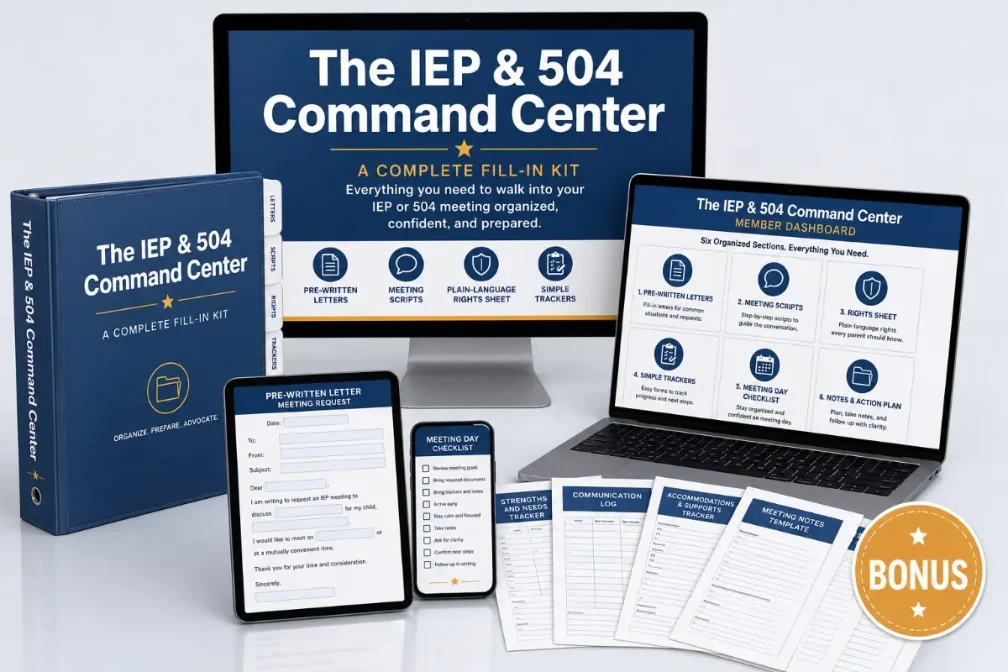
The IEP & 504 Command Center
This page shows you the deadlines and the contacts for your state. The Command Center hands you the done pieces: the binder built, the letters written, the meeting scripts ready and a self-review that shows where your child's IEP is strong or thin before you walk in. The library stays free.
Who to contact in California

- The state special education office. California Department of Education, Special Education Division. This is the office that answers questions about California rules and receives a state complaint.
- Your rights in writing. Notice of Procedural Safeguards. Every district hands parents this notice at least once a year (34 CFR 300.504). It is the plain summary of what you can ask for at each step.
- Parent training and information center. Team of Advocates for Special Kids (TASK). A parent center is free and federally funded under IDEA. Staff there talk families through the process in their own state at no cost.
- Parent training and information center. EPU Children's Center.
- Parent training and information center. Disability Rights Education and Defense Fund (DREDF).
- Parent training and information center. MATRIX Parent Network and Resource Center.
- Parent training and information center. Parents Helping Parents.
- Parent training and information center. Support for Families of Children with Disabilities.
- The state rules themselves. California Education Code, Part 30, Sections 56000 to 56865. Part 30 of the Education Code holds California's special education law, covering referral and assessment, IEP content and meetings, the local plan areas that run programs and the state complaint, mediation and hearing routes.
Child Find in California
California's child find duty reaches children from birth to age 21 and it names children who are not enrolled in public school programs. A local educational agency has to actively and systematically seek those children out rather than wait for someone to send a referral. The duty covers children who live in a school district as well as children under the jurisdiction of a special education local plan area or a county office of education. Each special education local plan area writes the policies its member agencies use for a continuous child find system. Those policies include written notice to families of their rights along with the procedure for starting a referral for assessment.
Source: Cal. Educ. Code Sections 56300 and 56301(d)(1) leginfo.legislature.ca.gov/faces/codes_displaySection.xhtml?lawCode=EDC§ionNum=56300