Vermont IEP Evaluation Timeline, Dispute Routes and Parent Resources (2026)
- Evaluation window
- 60 days
- The clock starts at
- Parental consent
- State complaint deadline
- Within one year
- Due process deadline
- Two years
How long does a school in Vermont have to complete an IEP evaluation?
Vermont keeps the federal 60 day clock for an initial special education evaluation, counted from the day the school district receives written parental consent, with a day meaning a calendar day under the state's own rules. Vermont adds a front end to that clock: within 15 calendar days of a request for an evaluation a district either asks for consent, convenes an Evaluation Planning Team meeting or puts its reasons for denying the request in writing. If the evaluation will run past 60 days, the family receives written notice of the delay with a schedule of evaluation activities before those 60 days expire, which the rule allows only for documented exceptional circumstances. Vermont rules also state that running a student through response to intervention or a multi-tiered system of supports cannot delay or deny the evaluation of a student suspected of having a disability, a point 16 V.S.A. Section 2902(g) carries in statute by barring a school district from using the tiered system to deny a timely initial comprehensive evaluation. When a family and a school disagree, all three routes run through the Vermont Agency of Education: an administrative complaint to the Secretary of Education about something in the past year, free voluntary mediation through the Agency's Special Education Mediation Service or a due process hearing before a licensed attorney appointed as hearing officer.

The evaluation timeline in Vermont
| Initial evaluation window | 60 days |
|---|---|
| The clock starts at | parental consent to evaluate |
| Against the federal rule | The federal default, unchanged |
IDEA sets a default of 60 calendar days from parental consent for an initial evaluation (34 CFR 300.301(c)(1)). Vermont keeps that default rather than setting a timeframe of its own.
Vermont follows the federal 60 day default for completing the evaluation and issuing the report. A district has a separate 15 calendar days after a referral to respond with a consent request, a planning meeting or a written denial.
Source: Vermont Special Education Rules Section 2362.2.1 education.vermont.gov/sites/aoe/files/edu-vermont-special-education-state-imposed-rules.pdf
The same window sits beside all fifty-one jurisdictions on the evaluation timelines by state table, which explains where the federal deadline comes from. To pull one state's window on its own, the evaluation deadline checker returns that single result.
Reevaluation and IEP review cadence in Vermont
Vermont writes the reevaluation rhythm into its own rules rather than adopting the federal text by reference. The numbers land in the same place: a reevaluation at least once every three years unless the parent plus the district agree one is unnecessary, no more than once a year unless both sides agree otherwise, with the IEP team reviewing the IEP at least annually. What Vermont adds sits around that three year mark. Rule 2362(b) applies the same three eligibility questions at a reevaluation that applied the first time, including whether the student needs special education services that cannot be provided through the school's educational support system, standard instructional conditions or supplementary aids and services. A September 2024 memo from the State Director of Special Education closed a reading of Rule 2363.11(c) that some districts had used: when a student moves districts mid-evaluation, the new district can document a new expected completion date only for an initial evaluation, so a move does not push out the three year reevaluation deadline. At kindergarten transition, Rule 2361.4(a)(1) sets the reevaluation date three years from the evaluation date named on the student's current IEP.
Source: Vermont Special Education Rules Section 2362.2.3(b), which sets the once a year limit at (b)(1) and the three year cycle at (b)(2), read with Rule 2363.6(c)(1) on the annual IEP review, Rule 2362(b) applying the eligibility criteria again at a reevaluation, Rule 2361.4(a)(1) on the kindergarten transition date and the Agency of Education memo Update to State Board Rule 2363.11 dated September 19, 2024 education.vermont.gov/sites/aoe/files/documents/edu-vt-state-board-of-education-rule-series-2360-revised-5-13-2021.pdf
If you disagree in Vermont
IDEA gives families in every state the same three routes when a disagreement with the school does not resolve at the team table. What changes at the state line is who administers each route, how long you have to file and the local detail below.
The state complaint
Handled by Vermont Agency of Education, decided by the Secretary of Education. Time limit to file: Within one year of the alleged violation.
Vermont calls this route an administrative complaint. Any person or organization sends a signed written complaint to the Secretary of Education, alleging that a local education agency or another public agency broke Part B of IDEA or the federal or state rules that carry it out. Vermont's rules define the local education agency as the supervisory union, unless a unanimous supervisory union vote limits that union to coordinating special education services for its member districts, which leaves the local school district as the agency answering the complaint. The complaint raises a violation that happened no more than one year before the Agency receives it. Whoever files sends a copy to the district or supervisory union serving the child at the same time. The Secretary appoints a complaint investigator who examines the evidence from both sides and can work by document review, a meeting, a hearing, an on site investigation or a combination of those. Once the Agency confirms receipt, the person who filed gets 15 days to add information by phone or in writing. A written decision follows within 60 days, extended only for exceptional circumstances or when both sides agree to extend the time to try mediation. Rule 2365.1.5(i) makes that decision final inside the Agency with no appeal, though the same subject can still go to a due process hearing where the hearing officer takes it fresh. A concern about a Section 504 plan takes a different road on this route: the Agency points families to the U.S. Department of Education Office for Civil Rights.
Source: Vermont Special Education Rules Section 2365.1.5, which sets the one year window at subsection (c), the copy to the district at (d), the complaint investigator plus the 15 days to add information at (f) and (f)(2), the 60 day written decision at (f)(4) and the no appeal provision at (i); Rule 2361.1(x) defines the local education agency; the Agency of Education dispute resolution page states the Section 504 referral to the Office for Civil Rights education.vermont.gov/sites/aoe/files/documents/edu-vt-state-board-of-education-rule-series-2360-revised-5-13-2021.pdf
Mediation
Mediation is voluntary for the family and for the school, free to both, run by the Agency of Education through its Special Education Mediation Service, which is where written requests go. The Agency keeps the list of qualified impartial mediators trained in mediation technique, the Secretary assigns one from that list on a random, rotational or other impartial basis and the Secretary provides the mediator at no cost to either side. A mediator cannot be an employee of the Agency, a district or another public agency involved in the child's education or care. Assignment happens no later than five days after a joint written request, or after one party's written request plus confirmation from the other side. Everyone signs a confidentiality pledge before the session starts, so what people say there stays out of a later hearing or court case. A district may bring a lawyer to mediation only when the family brings one. An agreement gets written down, signed by both sides plus the mediator, is enforceable in state or federal court and becomes part of the child's education record or is referenced in the IEP. Mediation can run before or after a due process request, alongside an administrative complaint or on its own. The Agency added a separate free service as a pilot in the 2025-2026 school year: a trained neutral facilitator at an IEP team meeting, available only when the family and the school ask for it together.
Source: Vermont Special Education Rules Section 2365.1.4, which makes mediation voluntary at subsection (b), sets the no cost provision at (c), routes written requests to the Special Education Mediation Service at (d), puts the mediator list with the Agency at (e), sets the mediator requirements plus the five day assignment at (f)(2) through (f)(4), the counsel parity rule at (h), the confidentiality pledge at (j) and the education record placement at (l); 16 V.S.A. Section 2959(b); the Agency of Education dispute resolution page describes the 2025-2026 IEP facilitation pilot education.vermont.gov/sites/aoe/files/documents/edu-vt-state-board-of-education-rule-series-2360-revised-5-13-2021.pdf
A due process hearing
Time limit to file: Two years from when the party knew or should have known about the alleged action, with a separate 90 day limit for a claim seeking reimbursement of a unilateral placement.
A parent, a district or a supervisory union files a written due process complaint with the Secretary of Education. Vermont sets the two year limit in statute at 16 V.S.A. Section 2957(a), measured from the alleged violation or from the date it reasonably should have been discovered, with the rules carrying the same figure. A claim for reimbursement of a unilateral special education placement carries its own 90 day limit measured from the placement. Where a family never received proper notice of special education rights, including notice of these limits, the clock runs from the day proper notice arrives. The two year limit also lifts where a district misrepresented that it had resolved the problem or withheld information IDEA required it to share. The instructions on Vermont's own complaint form for parents, students and guardians cover Section 504 of the Rehabilitation Act alongside IDEA, naming the adequacy of a Section 504 plan plus district compliance with Section 504 among the issues a complaint can raise, which the Agency's dispute resolution page repeats in a line of its own. Hearing officers are licensed attorneys drawn from a list the Agency keeps. Nobody employed by the Agency or the district can hear the case. Within three business days of receiving the complaint the Secretary names the hearing officer in writing and sets an initial telephone conference, which is held no later than five business days from receipt. The Agency's complaint form tells families that its Legal Unit Administrator makes that contact. A hearing runs to two business days unless the hearing officer finds good cause for longer. The written decision arrives within 45 days after the resolution period ends, though a hearing officer can extend that period at a party's request. The decision stands as the final decision of the Agency of Education and can be taken to a state or federal court within 90 days of notice of it. The Agency publishes its hearing officer orders by docket number on its dispute resolution page.
Source: 16 V.S.A. Section 2957, which sets the two year limit at subsection (a), the 90 day unilateral placement limit at (b), the notice tolling rule at (c) and the 90 day court appeal window at (d); Vermont Special Education Rules Sections 2365.1.6.1(a), 2365.1.6.4(b) on the two business day hearing plus the final decision, 2365.1.6.7(a) on the three day scheduling notice plus the five business day conference, 2365.1.6.16(a) and (b) on the 45 days plus extensions and 2365.1.7 on the hearing officer; the Agency of Education Due Process Complaint Notice for parents, students and guardians states the Section 504 coverage plus the Legal Unit Administrator contact, which the Agency's dispute resolution page repeats for Section 504 legislature.vermont.gov/statutes/section/16/101/02957
From the team behind this library
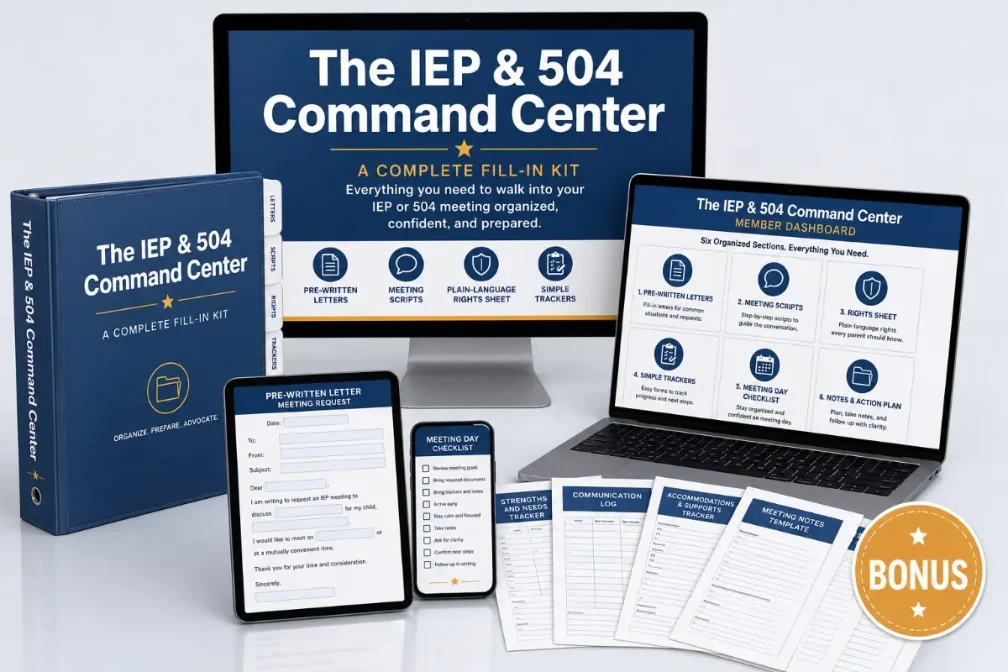
The IEP & 504 Command Center
This page shows you the deadlines and the contacts for your state. The Command Center hands you the done pieces: the binder built, the letters written, the meeting scripts ready and a self-review that shows where your child's IEP is strong or thin before you walk in. The library stays free.
Who to contact in Vermont

- The state special education office. Vermont Agency of Education, Special Education Team. This is the office that answers questions about Vermont rules and receives a state complaint.
- Your rights in writing. Notice of Procedural Safeguards: Rights of Parents of Students with Disabilities (effective October 19, 2022). Every district hands parents this notice at least once a year (34 CFR 300.504). It is the plain summary of what you can ask for at each step.
- Parent training and information center. Vermont Family Network. A parent center is free and federally funded under IDEA. Staff there talk families through the process in their own state at no cost.
- The state rules themselves. 16 V.S.A. chapter 101, Special Education (Sections 2941 through 2975). Chapter 101 is Vermont's special education statute, covering the Secretary of Education's authority over special education, essential early education for children three through five, the deadlines for filing a due process case or a court appeal, residential placement review, the census grant that funds supervisory unions plus the rulemaking that produced the State Board of Education's special education rules.
Child Find in Vermont
Vermont puts a comprehensive child find system for ages birth through 21 on each local education agency, reaching students who are homeless, in State custody, attending an independent school, enrolled in home study or advancing from grade to grade. Two placement rules shape where a family starts. For a student age five through 21 whose parents placed them in an independent elementary or secondary school outside their district of residence, child find belongs to the district where that independent school sits rather than the home district, which matters in a state where many towns tuition students to independent schools. For a child under three, a district can meet the duty through a regional agreement with a Children's Integrated Services early intervention program. The district acts as a primary referral source to that program. Districts give public notice before any significant child find activity, the Agency of Education runs a notice in major newspapers and notices appear in the native languages of the state's major population groups. Children ages three through five are served through what Vermont calls Essential Early Education, the state's name for IDEA Part B early childhood special education, delivered by the local education agency.
Source: Vermont Special Education Rules Section 2360.3, which places the birth through 21 duty on local education agencies at subsection (b), assigns the independent school situation at (b)(2), allows the regional early intervention agreement at (b)(3), sets the public notice steps at (c) and (e) and puts the primary referral role at (f); Rule 2361.2 covers early childhood special education for ages three through five education.vermont.gov/sites/aoe/files/documents/edu-vt-state-board-of-education-rule-series-2360-revised-5-13-2021.pdf