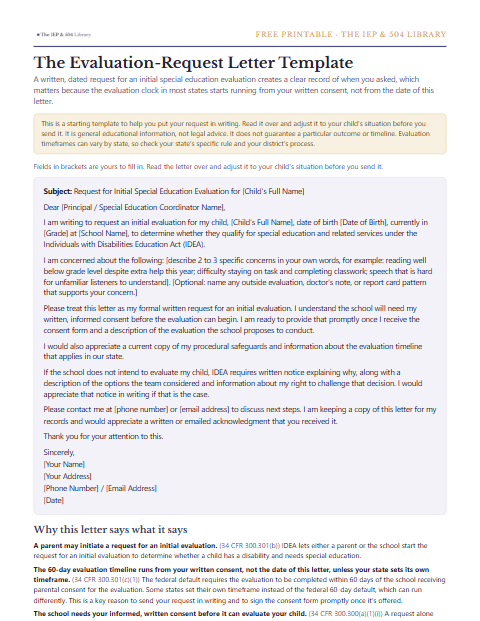
New York IEP Evaluation Timeline, Dispute Routes and Parent Resources (2026)
- Evaluation window
- 60 school days
- The clock starts at
- Written parental consent
- State complaint deadline
- One year
- Due process deadline
- Two years
How long does a school in New York have to complete an IEP evaluation?
In New York the outer deadline runs in school days: once a district receives signed parental consent, it has 60 school days to complete the evaluation, hold the Committee on Special Education meeting and arrange the programs and services the committee recommends. Because school days skip weekends, holidays and days the school is closed, that window sits well past the federal default of 60 calendar days from consent. The same regulation sets a separate 60 day completion figure for the evaluation itself, which the parent and the committee can extend by agreement. A family that disagrees with what the committee decides has three routes: a written state complaint to the Office of Special Education in Albany, free mediation through a community dispute resolution center or a due process complaint heard by an impartial hearing officer. Outside New York City the local school board appoints that hearing officer from the state list, while New York City hearings are held by hearing officers of the city's Office of Administrative Trials and Hearings. New York adds a further layer, since a State Review Officer at the department's Office of State Review can review the hearing decision before anyone goes to court.

The evaluation timeline in New York
| Initial evaluation window | 60 school days |
|---|---|
| The clock starts at | receipt of signed parental consent |
| Against the federal rule | A timeframe New York sets for itself |
IDEA sets a default of 60 calendar days from parental consent for an initial evaluation (34 CFR 300.301(c)(1)). It also lets a state set its own timeframe instead, which is what New York has done, so the window above is the one that applies here.
New York measures its 60 day window in school days rather than calendar days, which stretches the real-world window beyond the federal 60 calendar days. The clock starts on the day the district receives signed consent, not on the day the family sends the initial referral letter.
Source: 8 NYCRR 200.4 www.law.cornell.edu/regulations/new-york/8-NYCRR-200.4
The same window sits beside all fifty-one jurisdictions on the evaluation timelines by state table, which explains where the federal deadline comes from. To pull one state's window on its own, the evaluation deadline checker returns that single result.
Reevaluation and IEP review cadence in New York
New York keeps the same cadence as the federal rules: a reevaluation at least once every three years unless the district and the parent agree in writing that it is unnecessary, no more than once a year unless both agree otherwise, plus an IEP review at least annually. One New York addition sits at the end of that cycle. When a reevaluation leads the Committee on Special Education to decide a student is no longer a student with a disability, the recommendation identifies declassification support services for the student or for the student's teachers, running no longer than one year after the student enters the full time general education program. Those services can include counseling, speech and language services, social work services, psychological services or consultation for the student's teachers.
Source: 8 NYCRR 200.4(b)(4), 200.4(c)(3), 200.4(d)(1)(iii) and 200.4(f); definition at 8 NYCRR 200.1(ooo) www.law.cornell.edu/regulations/new-york/8-NYCRR-200.4
If you disagree in New York
IDEA gives families in every state the same three routes when a disagreement with the school does not resolve at the team table. What changes at the state line is who administers each route, how long you have to file and the local detail below.
The state complaint
Handled by Office of Special Education, New York State Education Department. Time limit to file: One year from the date of the alleged violation.
A state complaint is written, signed by the person filing it and sent to the Office of Special Education in Albany, with a copy going to the school district serving the child at the same time. The department reviews the allegations, can carry out an on-site investigation when it decides one is necessary and issues a written decision with findings of fact within 60 calendar days of receiving the complaint. The investigating work sits with the department's seven regional Special Education Quality Assurance units, which look into complaints that a public or private special education program is not following federal or state requirements.
Source: 8 NYCRR 200.5(l), including (l)(1)(iii)(a), (l)(1)(v) and (l)(2)(vi); NYSED state complaint page www.law.cornell.edu/regulations/new-york/8-NYCRR-200.5
Mediation
Mediation in New York runs through the community dispute resolution centers that cover all 62 counties under article 21-A of the Judiciary Law, rather than through mediators employed by the education department. Those centers deliver special education mediation under contract with the State Education Department, which approves the mediators and pays for the sessions, so mediation costs families nothing and costs districts nothing. It is voluntary for both sides. A parent asks for it in writing to the Committee on Special Education, the Committee on Preschool Special Education or the district board of education rather than to the department in Albany. The department's Special Education Dispute Resolution Center answers questions about starting the process.
Source: Education Law 4404-a; 8 NYCRR 200.5(h)(1) and (h)(4); NYSED special education mediation page www.nysenate.gov/legislation/laws/EDN/4404-A
A due process hearing
Time limit to file: Two years from the date the parent knew or should have known about the action the complaint is about.
New York runs a two level administrative review, so an impartial hearing decision is not the last administrative word. Outside New York City the local board of education appoints the impartial hearing officer from the state list through a rotational selection process, which the district starts within two business days of receiving the complaint. Inside New York City the hearings are held by impartial hearing officers of the city's Office of Administrative Trials and Hearings, under a December 2021 agreement among that office, the city education department and the State Education Department. The regulation defining an impartial hearing officer makes room for that arrangement in a city school district with one million or more residents. Either side can then ask a State Review Officer at the department's Office of State Review to review the hearing decision, by serving a request for review within 40 days of that decision. The two year filing limit does not apply where the district misrepresented that it had resolved the problem or held back information it was required to give the parent.
Source: 8 NYCRR 200.5(j)(1)(i), 200.5(j)(3)(i) and 200.5(k); 8 NYCRR 200.1(x) and 279.4; Education Law 4404(1), (2) and (3) www.law.cornell.edu/regulations/new-york/8-NYCRR-200.5
From the team behind this library
The IEP & 504 Command Center
This page shows you the deadlines and the contacts for your state. The Command Center hands you the done pieces: the binder built, the letters written, the meeting scripts ready and a self-review that shows where your child's IEP is strong or thin before you walk in. The library stays free.
Who to contact in New York

- The state special education office. Office of Special Education, New York State Education Department. This is the office that answers questions about New York rules and receives a state complaint.
- Your rights in writing. Procedural Safeguards Notice: Rights for Parents of Preschool and School-Age Students with Disabilities (May 2024 edition), published by the New York State Education Department with translations posted beside the English edition. Every district hands parents this notice at least once a year (34 CFR 300.504). It is the plain summary of what you can ask for at each step.
- Parent training and information center. Starbridge. Serving New York State except the five boroughs of New York City and Long Island. A parent center is free and federally funded under IDEA. Staff there talk families through the process in their own state at no cost.
- Parent training and information center. Advocates for Children of New York. Serving The five boroughs of New York City.
- Parent training and information center. INCLUDEnyc. Serving The five boroughs of New York City.
- Parent training and information center. Sinergia/Metropolitan Parent Center. Serving The five boroughs of New York City.
- Parent training and information center. Long Island Advocacy Center. Serving Nassau and Suffolk counties.
- The state rules themselves. New York Education Law, article 89 (sections 4401 through 4410-c); implementing rules at 8 NYCRR part 200. Article 89, titled Children With Disabilities, is New York's own special education statute covering who is eligible, the duties of school districts and of the education department, impartial hearings plus State Review Officer appeals, the mediation program and preschool special education, with the operating detail carried in part 200 of the Commissioner's regulations.
Child Find in New York
New York splits the school age and the preschool systems. A school age referral goes to the district's Committee on Special Education. A referral for a child who is not yet school age goes instead to a Committee on Preschool Special Education, which also seats a certified or licensed professional appointed by the chief executive of the municipality where the child lives. The preschool evaluation is carried out by a state approved evaluation program that the parent picks from a list the board of education provides, rather than by district staff. That committee meets to review the results and develop a recommendation within 60 calendar days of consent. The board then arranges the recommended programs and services no later than 30 school days after the recommendation and within 60 school days of consent.
Source: Education Law 4410(3) and 4410(4); 8 NYCRR 200.16(c)(1), 200.16(e)(1) and 200.16(f)(1) www.nysed.gov/special-education/section-20016-educational-programs-preschool-students-disabilities