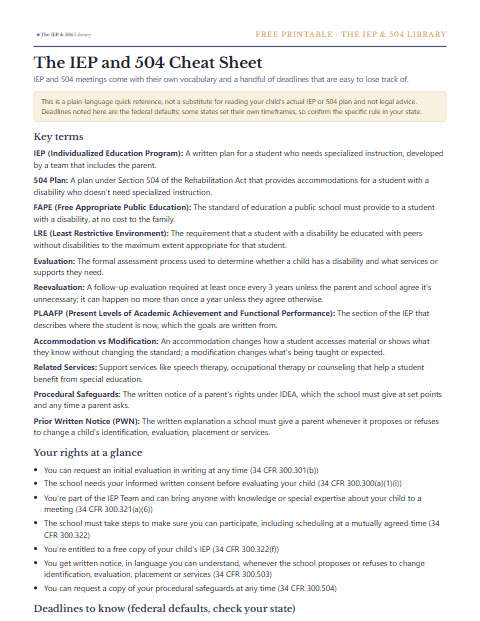
The 13 IDEA Disability Categories That Qualify for an IEP
IDEA lists thirteen disability categories a child can qualify under for an IEP: autism, deaf-blindness, deafness, emotional disturbance, hearing impairment, intellectual disability, multiple disabilities, orthopedic impairment, other health impairment, specific learning disability, speech or language impairment, traumatic brain injury and visual impairment including blindness (34 CFR 300.8). A category alone is not enough. A child qualifies only if the disability also means the child needs special education, which is the second half of the test. Developmental delay is a separate optional category some states use for younger children, not one of the thirteen.

How IEP eligibility works
A child qualifies for an IEP when the child has a disability in one of the thirteen categories and needs special education because of it.
Eligibility under IDEA has two parts. First, an evaluation has to find that the child has a disability in one of the thirteen categories defined at 34 CFR 300.8. Second, the disability has to mean the child needs special education, meaning specially designed instruction, not accommodations alone. A child can have a diagnosis and still not need special education, in which case a 504 plan may be the better fit.
The categories are legal eligibility terms, not a description of who a child is. Two children in the same category can have very different strengths, needs and goals, because the IEP is built from the individual evaluation, not from the category label. The plain descriptions below follow the regulation's own definitions.
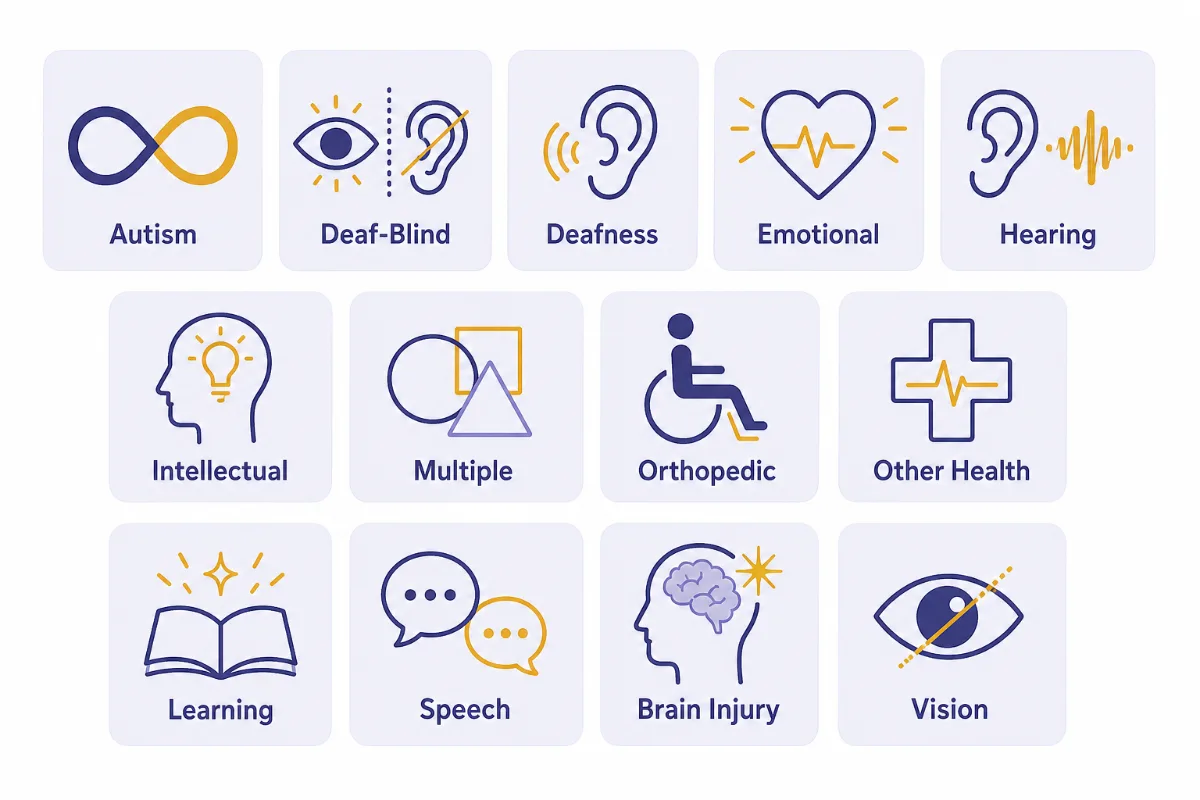
1. Autism
A developmental disability that affects communication, social interaction and learning, usually evident before age three.
Under IDEA, this category covers a student whose autism significantly affects verbal and nonverbal communication and social interaction in a way that impacts education. The autistic community largely prefers identity-first language, so many families and self-advocates say autistic student rather than student with autism. Either way, the plan is built from the individual evaluation.
2. Deaf-blindness
Both a hearing loss and a vision loss together, whose combined effect needs supports beyond a program for one alone.
This is its own category because the combination of hearing and vision loss creates communication and learning needs that a program built only for deafness or only for blindness would not meet.
3. Deafness
A hearing loss so severe that the student does not process spoken language through hearing, with or without amplification.
Deafness is a distinct category from a milder hearing impairment because it changes how a student accesses language and instruction, which shapes the supports and communication approach in the IEP.
4. Emotional disturbance
A condition, over a long time and to a marked degree, that affects learning, such as an anxiety disorder or depression.
This is the term the regulation uses, though many families and professionals prefer emotional disability. It can cover conditions such as an anxiety disorder, depression or another mental-health condition when it affects the student's education over time. It does not apply to a student who is socially maladjusted unless the student also meets this definition.
5. Hearing impairment
A hearing loss, permanent or changing, that affects learning but is not severe enough to fall under deafness.
A student in this category has some functional hearing that affects education. The IEP often addresses access to sound, seating, technology and language support.
6. Intellectual disability
Significantly below-average general intellectual functioning with limits in adaptive behavior, present during childhood.
IDEA uses the term intellectual disability, which replaced an older term through Rosa's Law. Eligibility looks at both intellectual functioning and adaptive skills such as communication, self-care and daily living, drawn from the evaluation rather than a single test score.
7. Multiple disabilities
Two or more disabilities together whose combined effect needs supports a program for any one alone would not provide.
This category is used when disabilities occur together, such as an intellectual disability with an orthopedic impairment, in a way that a single-category program cannot address. It does not include deaf-blindness, which is its own category.
8. Orthopedic impairment
A physical impairment that affects a student's movement or access at school, such as from cerebral palsy.
This category covers a physical condition that affects a student's participation at school, for example a student who uses a wheelchair or has limited mobility. The IEP often addresses physical access, positioning and any related therapy.
9. Other health impairment
Limited strength, energy or alertness from a chronic or acute health condition that affects learning.
This is the category that most often serves ADHD. It also covers conditions such as asthma, epilepsy, diabetes or a heart condition when they affect the student's school day. The health condition has to limit alertness or energy in a way that affects learning.
10. Specific learning disability
A disorder in the basic processes of understanding or using language, such as dyslexia, dyscalculia or dysgraphia.
This is one of the most common categories. It covers a gap between ability and achievement in areas such as reading, writing, listening, speaking or math that is not explained by another cause. Dyslexia is a specific learning disability in reading.
11. Speech or language impairment
A communication disorder such as stuttering, an articulation problem or a language impairment that affects learning.
This category covers difficulty producing speech sounds, fluency such as stuttering, voice or understanding and using language, when it affects the student's education. Speech-language services are the usual support.
12. Traumatic brain injury
An acquired injury to the brain from an external physical force that affects learning or behavior.
This category applies to a brain injury caused by an outside force, such as from an accident, that affects areas like memory, attention, reasoning or behavior. It does not include injuries that are congenital or caused by birth trauma.
13. Visual impairment including blindness
A vision loss that, even with correction, affects learning. It covers both partial sight and blindness.
This category includes students with low vision and students who are blind. The IEP often addresses accessible materials, braille where appropriate and orientation and mobility support.
Developmental delay: the optional fourteenth category
Developmental delay is not one of the thirteen. It is a separate optional category a state may use for young children.
Some lists wrongly count developmental delay among the thirteen. Under 34 CFR 300.8(b), it is a separate optional category that a state and its districts may choose to use for children ages three through nine, or a subset of that range. Where a state adopts it, it lets a young child qualify without pinning down one of the thirteen categories yet. Where a state does not adopt it, it is not available.
This is a common point of confusion, so it is worth stating plainly: the thirteen categories are fixed by IDEA. Developmental delay sits alongside them as a state option for younger children, not as a fourteenth mandatory category.
A category is a starting point, not a label
The category opens the door to an IEP; the individual evaluation shapes the actual goals and supports.
Once a child qualifies under a category, the IEP is written from the child's own present levels, strengths and needs, not from the category name. That is why our goal bank is organized by skill area rather than by category, since two children under the same category can need very different goals. If your child was found not eligible for an IEP, a 504 plan may still fit, which our guide on what qualifies for a 504 plan explains.
From the team behind this library
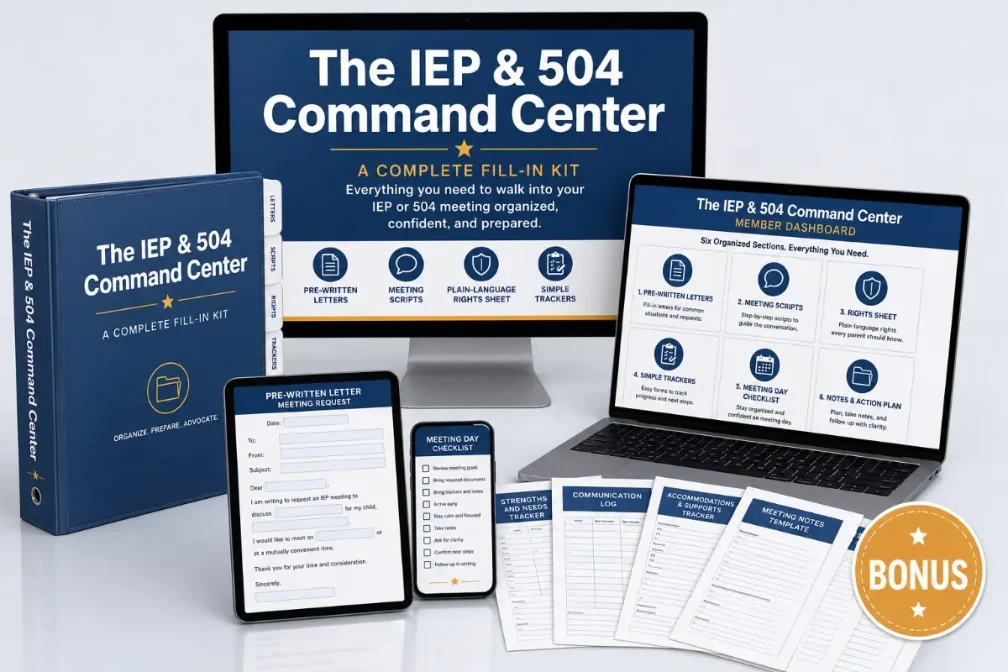
The IEP & 504 Command Center
This page shows the options to discuss. The Command Center hands you the done pieces: the binder built, the letters written, the meeting scripts ready and a self-review that shows where your child's plan is strong or thin. The library stays free.