IEP vs 504: What's the Difference
An IEP and a 504 plan come from two different federal laws and do two different jobs. An IEP comes from the Individuals with Disabilities Education Act (IDEA) and provides specialized instruction plus related services under a plan of measurable goals, for a child who fits one of thirteen disability categories and needs special education because of it. A 504 plan comes from Section 504 of the Rehabilitation Act, a civil rights law. It provides accommodations that give a child equal access to the general education program, for a child with a physical or mental impairment that substantially limits a major life activity, whether or not that child needs specialized instruction. A child who qualifies for an IEP automatically meets Section 504's requirement too, so a school does not usually write both.
Where each one comes from
An IEP is required by the Individuals with Disabilities Education Act, a special education law. A 504 plan is required by Section 504 of the Rehabilitation Act, a civil rights law that bars disability discrimination in any program that receives federal funding, including public schools.
IDEA (20 U.S.C. 1400 and its regulations at 34 CFR Part 300) is a federal grant program. It gives states federal funding to help cover the cost of special education in exchange for meeting IDEA's requirements, authorized under 20 U.S.C. 1411.
Section 504 (29 U.S.C. 794 and its regulations at 34 CFR Part 104) is not a special education law or a funding program. It is a civil rights law: no otherwise qualified person with a disability can be excluded from, denied the benefits of or discriminated against in any program that receives federal financial assistance. A public school qualifies because it receives federal funds, so Section 504 applies whether or not the school ever touches IDEA money.
Who qualifies for each one
IDEA uses a narrower two-part test: your child must fit one of thirteen listed disability categories and need special education because of it. Section 504 uses a broader test: a physical or mental impairment that substantially limits one or more major life activities, with no list of categories and no requirement that the child need specialized instruction.
Under IDEA, a child with a disability is a child who fits one of the thirteen disability categories the regulation defines: autism, deaf-blindness, deafness, emotional disturbance, hearing impairment, intellectual disability, multiple disabilities, orthopedic impairment, other health impairment, a specific learning disability, a speech or language impairment, traumatic brain injury or a visual impairment including blindness. That child also has to need special education and related services because of the condition (34 CFR 300.8(a) and (c)). Both parts of that test have to be true. A child can have a diagnosed condition on the list and still not qualify for an IEP if the condition does not create a need for specialized instruction. Developmental delay is a separate matter: a state may allow its districts to use a developmental delay category for children ages 3 through 9, but that is an option each state chooses rather than one of the core thirteen (34 CFR 300.8(b)).
Section 504 defines a person with a disability more broadly: someone with a physical or mental impairment that substantially limits one or more major life activities such as learning, concentrating, reading, communicating or caring for oneself (34 CFR 104.3(j)). There is no fixed list of qualifying conditions and no separate requirement that the child need specialized instruction, only that the impairment substantially limits a major life activity. The ADA Amendments Act of 2008 broadened this standard further, directing schools to read substantially limits generously rather than as a high bar, so more students qualify for a 504 evaluation today than before 2008.
What each one actually provides
An IEP provides specialized instruction, related services and a set of measurable annual goals the school tracks. A 504 plan provides accommodations and related aids and services inside the general education classroom, with no separate goals document and no obligation for specialized instruction.
An IEP is built around measurable annual goals (34 CFR 300.320(a)(2)) and the specialized instruction and related services, like speech therapy or occupational therapy, that the team decides your child needs to reach them. It is a bigger document with more moving parts because it changes how your child is taught, not only where or how they access the same instruction as their classmates.
A 504 plan changes access rather than instruction. Typical accommodations include extended time on tests, preferential seating, a reduced-distraction setting or a copy of class notes. The regulation still requires a free appropriate public education for a 504-eligible student: regular or special education and related aids and services designed to meet that student's needs as adequately as the needs of nondisabled students are met (34 CFR 104.33). It does not require the specialized, goal-driven instruction an IEP does.
How the evaluation process differs
Both laws require an evaluation before a plan is written and both require using more than one source of information, but IDEA's evaluation is built to answer whether specialized instruction is needed, while Section 504's evaluation is built to answer whether a major life activity is substantially limited.
Under IDEA, the school must draw on a variety of assessment tools and cannot rely on a single test. The evaluation has to be comprehensive enough to identify every one of your child's special education needs (34 CFR 300.304). A group of qualified professionals and you together decide eligibility. The school must give you a free copy of the evaluation report and the eligibility decision (34 CFR 300.306).
Section 504's evaluation similarly requires validated tests given by trained personnel and information drawn from a variety of sources, including teacher input and background information, with the placement decision made by a group of people who know the child, the evaluation data and the placement options (34 CFR 104.35). Because the eligibility question is different, an evaluation built for an IEP does not automatically answer the 504 question. The reverse is also true.
How rights and enforcement differ
Both laws give you procedural safeguards, but they run through different systems. IDEA disputes go through your state's special education complaint and due process system, which the U.S. Department of Education's Office of Special Education Programs oversees. Section 504 disputes go through the Office for Civil Rights.
IDEA requires a system of procedural safeguards including written notice, the right to review records and the right to an impartial due process hearing, with specific rights tied to the IEP process (34 CFR 300.503 and 34 CFR Part 300, subpart E). The Department of Education's Office of Special Education Programs (OSEP) is the federal office responsible for IDEA policy and state oversight.
Section 504 requires its own system of procedural safeguards: notice, an opportunity to review records, an impartial hearing with the right to counsel and a review procedure (34 CFR 104.36). A parent who believes a school is not meeting its Section 504 obligations can file a complaint with the Office for Civil Rights (OCR), the federal office that enforces Section 504 in schools.
Needing both and switching between them
A child eligible for an IEP is automatically covered by Section 504 too, so a school does not typically write a separate 504 plan on top of an IEP. A child who does not qualify for an IEP can still qualify for a 504 plan on its own.
The Department of Education has stated that implementing an IEP is one way a school satisfies its Section 504 obligations, since IDEA eligibility already meets Section 504's broader disability definition. In practice, a child with an IEP does not also carry a separate 504 plan for the same needs.
The reverse is not true. A child can meet Section 504's broader impairment test without meeting IDEA's narrower two-part test, most often when the impairment substantially limits a major life activity but the child does not need specialized instruction to access the curriculum. That child gets a 504 plan instead of an IEP. If your child's needs change, either evaluation can be requested again. A team that starts with a 504 plan can move to an IEP evaluation if the accommodations stop being enough.
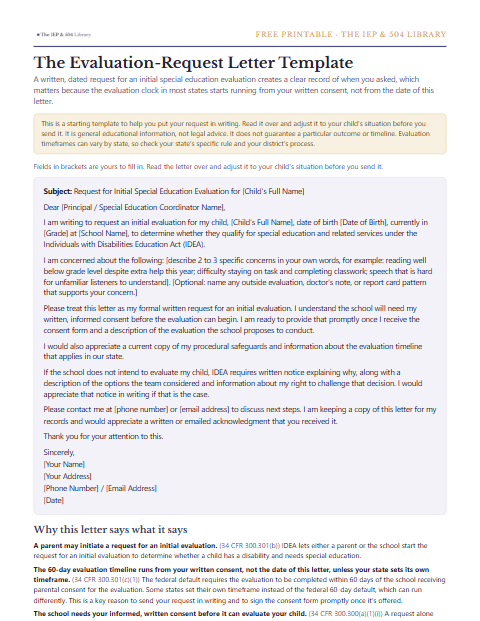
Get the free Evaluation-Request Letter Template (PDF)
A ready-to-adapt letter to request an evaluation in writing, with the dates that matter and the language to use.
We email you the PDF, plus a note if the guidance on this topic changes. Unsubscribe anytime.