IEP Goals for Autism
What IEP goals connect to Autism?
IEP goals for an autistic student most often cross three areas: communication, social connection and self-regulation, alongside any academic goals the evaluation shows are needed. A strong goal names a starting point, a measurable target and how progress is checked. It builds a skill the student can use rather than asking them to hide who they are. The examples below are starting points to shape with your child's team, not goals to copy.
What a measurable Autism goal looks like
A measurable annual goal names the skill, the starting point, the condition, the criterion and how it is measured. IDEA requires annual goals to be measurable (34 CFR 300.320(a)(2)), so 'will improve social skills' is not enough; a goal names a number of reciprocal turns, a count of independent requests or a percentage of opportunities. For an autistic student the strongest goals build communication, coping and self-advocacy the student finds useful. They count every reliable way the student communicates, spoken or not.
Example goals by grade band
Each goal below is an example to discuss and adapt with your team, never a target your child must meet. The specific rates and percentages are illustrations of what a measurable goal looks like. To see how the parts fit together, try the goal practice builder.
Lower elementary (K-2)
Example · Communication
Given a visual choice board or an AAC device and a motivating activity, [student] will independently make a request (using a word, sign, symbol or device) in 8 of 10 opportunities across 3 consecutive sessions by the annual review date, as measured by teacher and speech-language data logs.
What to ask your team: Ask that the goal count any reliable way your child communicates (spoken, signed, symbol or device), not spoken words alone.
Example · Social
Given a structured small-group activity and a visual prompt, [student] will take a turn with a peer (passing an item, adding to a shared task or responding to a peer's turn) in 4 of 5 activities by the annual review date, as measured by teacher observation records.
What to ask your team: Ask what level of adult prompting the goal starts from and how the team will fade it over the year.
Example · Self-regulation
When [student] shows early signs of overwhelm, [student] will use a taught self-regulation strategy (requesting a break, moving to a calm space or using a sensory tool) in 4 of 5 observed instances by the annual review date, as measured by a teacher-recorded behavior log.
What to ask your team: Ask whether the strategies in the goal are ones your child chooses and finds calming, not ones imposed on them.
Upper elementary (3-5)
Example · Communication
Given a familiar conversation partner and a preferred topic, [student] will maintain a back-and-forth exchange for 3 or more reciprocal turns in 4 of 5 opportunities by the annual review date, as measured by speech-language session data.
What to ask your team: Ask whether the goal values your child's communication style rather than a fixed script of what to say.
Example · Social
During a cooperative classroom activity, [student] will initiate an interaction with a peer (asking to join, offering an item or making a comment) at least twice per activity in 4 of 5 activities by the annual review date, as measured by teacher observation.
What to ask your team: Ask how the goal accounts for days when your child prefers to work alone, so a quiet day is not scored as a failure.
Example · Self-regulation
Given a check-in tool or emotion scale, [student] will identify their current level of regulation and name one strategy that helps in 4 of 5 check-ins by the annual review date, as measured by a teacher-recorded self-monitoring chart.
What to ask your team: Ask what data the school collects between meetings so progress is measured, not guessed at the next review.
Middle school (6-8)
Example · Communication
In a general education class, [student] will ask for clarification or help when a task is unclear (raising a hand, using a help signal or messaging the teacher) in 4 of 5 observed opportunities by the annual review date, as measured by teacher data collection.
What to ask your team: Ask whether the goal offers more than one way to ask for help, so your child can use the one that fits them.
Example · Social
During a small-group assignment, [student] will contribute an idea and acknowledge a group member's idea (building on it, agreeing or respectfully offering a different view) in 4 of 5 group sessions by the annual review date, as measured by a teacher-completed group-participation rubric.
What to ask your team: Ask that the goal measure genuine participation, not eye contact or a specific body posture.
Example · Self-regulation
When a routine changes with little warning, [student] will use a coping strategy from their plan and return to the activity within 5 minutes in 4 of 5 observed instances by the annual review date, as measured by a teacher-recorded log.
What to ask your team: Ask whether the plan includes advance warning of changes where possible, since predictability often prevents the overwhelm the goal addresses.
High school (9-12) and transition
Example · Communication
In a self-advocacy setting, [student] will describe one of their own support needs and request the matching accommodation (in person or in writing) in 4 of 5 structured opportunities by the annual review date, as measured by counselor or case-manager data.
What to ask your team: Ask how this goal connects to the transition plan and life after high school, where self-advocacy carries the most weight.
Example · Social
In a group or community-based task, [student] will complete an assigned role and coordinate one hand-off with a partner in 4 of 5 tasks by the annual review date, as measured by a supervisor or teacher checklist.
What to ask your team: Ask that the goal reflect the student's own post-school interests, since transition goals must be based on their preferences.
Example · Self-regulation
Across the school day, [student] will independently recognize rising stress and apply a self-selected regulation strategy before it affects the task in 4 of 5 observed instances by the annual review date, as measured by a self-monitoring log reviewed with the case manager.
What to ask your team: Ask how the strategies transfer to a job, college or independent living, not just the classroom.
What makes a goal measurable
- Names a measurable criterion (a percentage, a count or a number of trials), not just 'will improve' or 'will tolerate'
- States how progress is measured and how often
- Counts every reliable way the student communicates, not spoken words alone
- Builds a skill the student can use, rather than suppressing a natural behavior
- Is written in respectful language that matches the student's and family's own preference, person-first or identity-first
- Is a starting point for the team, never a fixed prescription
Common mistakes to watch for
- A goal with no baseline, so there is no way to judge progress
- A goal that targets stopping a self-soothing behavior or requiring eye contact, rather than teaching a communication or coping skill the student can use
- Deficit-first wording that describes the child by what they cannot do
- The same goal copied across years with no change in the target
- A goal handed to the school as a finished script rather than a starting point the team shapes together
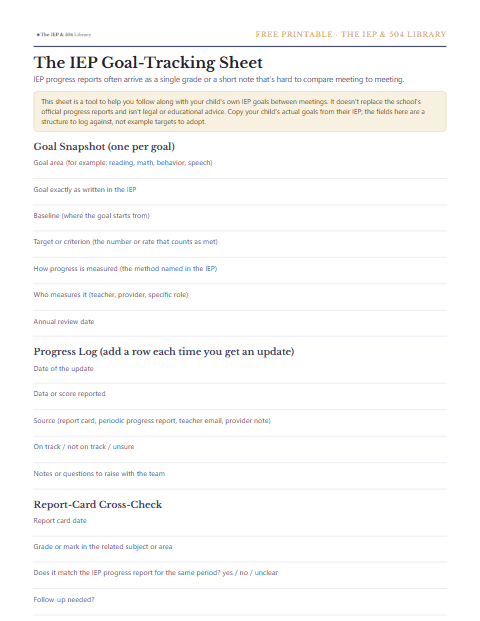
Get the free IEP Goal-Tracking Sheet (PDF)
One page per goal to log the baseline, the target and every progress update, so you see a pattern across the year.
We email you the PDF, plus a note if the guidance on this topic changes. Unsubscribe anytime.