The IEP Process, Start to Finish
The IEP process runs in a set order: identification through Child Find or a specific request, written consent, an evaluation completed within 60 days of that consent, a team decision on eligibility, an IEP written within 30 days of an eligibility decision, services beginning, a review at least once a year and a full reevaluation at least every three years. Several of these steps gate the ones that follow, so a delay at one step, most often a consent that has not been signed yet, is often the real reason the whole process feels stalled.
Step 1: Identification through Child Find or a referral
Schools carry a standing duty to identify children who may need special education. A parent, teacher or the school itself can also start a specific referral at any point.
Every school district has an ongoing duty called Child Find to identify, locate and evaluate every child suspected of needing special education, whether that child attends public school, is homeless or is enrolled in a private school in the district (34 CFR 300.111(a)). This duty exists independent of any single family asking for help.
A parent, a teacher or the school itself can also start a specific referral at any point, without waiting for the school to notice a need on its own. Either a parent or the public agency may initiate a request for an initial evaluation (34 CFR 300.301(b)).
Step 2: Consent for evaluation
Before any evaluation happens, the school must get your written consent. That consent does not commit you to any particular service.
The school must obtain informed parental consent before conducting an initial evaluation (34 CFR 300.300(a)(1)). Consent for evaluation and consent for services are two separate steps: agreeing to have your child evaluated does not commit you to any specific plan, since a later, separate consent is required before special education services can begin (34 CFR 300.300(b)(1)).
The date you sign the evaluation consent form is the date that starts the evaluation clock, so it is worth noting for your own records.
Step 3: The evaluation
The evaluation has to use a variety of tools and cannot rely on any single test to decide eligibility. It has to be finished within 60 days of your consent.
A team gathers information using a variety of assessment tools and strategies, covering functional, developmental and academic areas. No single test or measure can be used alone to decide eligibility (34 CFR 300.304(b)(2)). The tools also have to be technically sound and given in the child's native language or mode of communication where feasible (34 CFR 300.304(c)).
The evaluation must be completed within 60 days of the date you sign consent, unless your state has established its own timeframe, in which case that timeframe applies instead of the federal default (34 CFR 300.301(c)(1)).
Step 4: Eligibility determination
A group of qualified professionals and you, the parent, review the evaluation data together and decide eligibility as a team.
Upon completion of the evaluation, a group of qualified professionals and the parent of the child determines whether the child is a child with a disability, drawing on information from a variety of sources, all of it documented (34 CFR 300.306(a)-(c)). A child cannot be found eligible based only on a lack of appropriate instruction in reading or math or on limited English proficiency.
The school must give you a free copy of the evaluation report and the documentation of eligibility once this step is complete.
Step 5: The IEP meeting
Once your child is found eligible, the team has 30 days to meet and write the first IEP.
A meeting to develop an IEP for a child is conducted within 30 days of a determination that the child needs special education and related services (34 CFR 300.323(c)(1)). This meeting covers present levels of performance, measurable annual goals, the specific services and how progress will be tracked.
This is a separate 30-day clock from the 60-day evaluation clock in Step 3. It only starts once eligibility is actually decided.
Step 6: Placement
A group of people knowledgeable about your child, the evaluation data and the placement options decides where the IEP will be carried out, guided by the least restrictive environment principle.
The placement decision is made by a group of persons, including the parents and other persons knowledgeable about the child, the evaluation data and the placement options (34 CFR 300.116(a)(1)). Unless the IEP requires some other arrangement, the child is educated in the school they would attend if not disabled, as close as possible to home, with the group weighing any potential harmful effect of a more restrictive setting.
This is the least restrictive environment principle in practice: your child is educated alongside nondisabled peers to the extent the IEP allows, not automatically placed in a separate setting.
Step 7: Services begin
Once the IEP is finalized, services start as soon as possible so your child is not left waiting on a signed plan that is not yet being delivered.
Special education and related services are made available to the child in accordance with the IEP as soon as possible following the meeting where the IEP is developed (34 CFR 300.323(c)(2)). At the start of each school year, the school must have an IEP in effect for every child with a disability in its jurisdiction (34 CFR 300.323(a)).
If your child transfers to a new school district, the new district generally has to provide comparable services until it adopts the prior IEP or develops a new one.
Step 8: Annual review
At least once a year, the team meets again to review the IEP and check whether your child is meeting the annual goals.
The IEP team reviews the child's IEP periodically, but not less than annually, to determine whether the annual goals are being achieved (34 CFR 300.324(b)(1)(i)). The team revises the IEP to address insufficient progress, new evaluation data, information from you or the school, or anticipated needs.
Either you or the school can call a meeting sooner than the annual mark if something changes. Annual review is a floor, not a ceiling.
Step 9: Reevaluation
A full reevaluation happens at least once every three years. It can happen sooner if conditions change.
A full reevaluation must occur at least once every three years, unless the parent and the school agree it is unnecessary (34 CFR 300.303(b)(2)). It can also happen sooner if the school determines your child's needs warrant it or if you or a teacher requests one, though not more than once a year unless you and the school agree otherwise (34 CFR 300.303(a)-(b)(1)).
A reevaluation follows the same evaluation-procedure rules as the initial one: multiple sources of information and no single measure deciding the outcome alone.
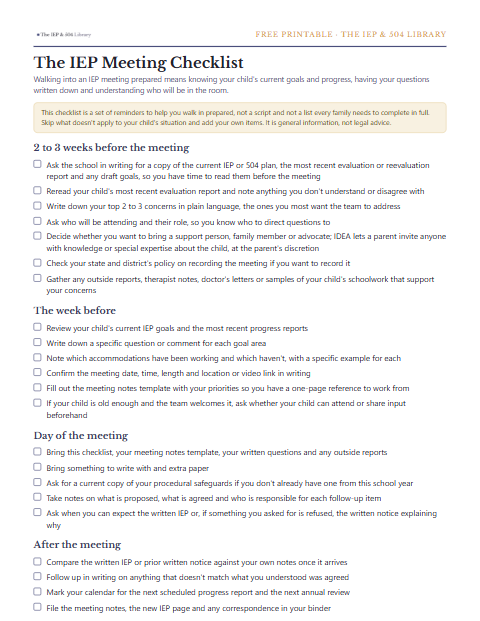
Get the free IEP Meeting Checklist (PDF)
The four-stage prep checklist, from a few weeks out through the follow-up, so nothing gets missed in a busy week.
We email you the PDF, plus a note if the guidance on this topic changes. Unsubscribe anytime.