IEP Adaptive and Functional Life Skills Goals
What are IEP adaptive and functional life skills goals?
Adaptive and functional goals cover the everyday skills that help a child take part in school and grow more independent. They include self-care and daily routines, functional academics like money and time, safety and community skills and the self-management skills of following a schedule, staying organized and asking for help. IDEA names functional goals right alongside academic ones, so an IEP can carry them when the evaluation shows a need. A well-written functional goal names where the child is starting, a measurable target and how progress is checked, so the team can see growth rather than guess at it. The examples below are starting points to shape with your child's team, not goals to copy.
What a measurable adaptive and functional life skills goal looks like
A measurable functional goal names the skill, the condition, the criterion and how it is measured. IDEA requires annual goals to be measurable and lists functional goals alongside academic ones (34 CFR 300.320(a)(2)), so a goal like 'will be more independent' is not enough; a strong goal names what the child will do, how well (a percentage, a count or a level of prompting) and how the team will check it. Because functional skills are used in real places like the hallway, the cafeteria and the community, the best goals also say where the skill is practiced and measured, not only on a worksheet.
Example goals by grade band
Each goal below is an example to discuss and adapt with your team, never a target your child must meet. The specific rates and percentages are illustrations of what a measurable goal looks like. To see how the parts fit together, try the goal practice builder.
Lower elementary (K-2)
Example · Self-care and dressing
Given the needed clothing items and one verbal reminder, [student] will put on and fasten a coat independently on 4 of 5 opportunities across two weeks by the annual review date, as measured by teacher observation records.
What to ask your team: Ask what level of help the goal assumes at the start and how the team plans to fade the prompts over the year.
Example · Following a classroom routine
Given a picture schedule and one verbal reminder, [student] will complete the arrival routine of unpacking, hanging the bag and joining morning meeting with no more than one adult prompt on 4 of 5 school days across two consecutive weeks by the annual review date, as measured by a daily routine checklist.
What to ask your team: Ask how many prompts your child needs now, so the goal moves forward from where they are rather than from zero.
Upper elementary (3-5)
Example · Functional money skills
Given coins and bills up to five dollars and a set of purchase cards, [student] will choose enough money to pay the amount shown with 80 percent accuracy on 4 of 5 trials by the annual review date, as measured by teacher-scored money-skills probes.
What to ask your team: Ask whether the goal uses real money and everyday tasks, so the skill carries over outside the worksheet.
Example · Organizing personal materials
Given a homework folder and an end-of-day checklist, [student] will pack the materials needed for home with 90 percent accuracy on 4 of 5 school days across two weeks by the annual review date, as measured by a staff-completed packing checklist.
What to ask your team: Ask what support, such as a visual checklist or a set reminder time, the school will put in place while the skill is still building.
Middle school (6-8)
Example · Following a daily schedule
Given a personal schedule and a watch or phone timer, [student] will arrive at the correct room for each class period before the bell on 4 of 5 school days across two consecutive weeks by the annual review date, as measured by a period-by-period tracking sheet.
What to ask your team: Ask how the team defines on time and how they will collect the data without singling your child out in front of classmates.
Example · Self-advocacy and asking for help
Given a task that is too hard or unclear, [student] will use a taught strategy to ask an adult for help, such as showing a help card or stating the need, on 4 of 5 observed opportunities across a grading period by the annual review date, as measured by teacher tally records.
What to ask your team: Ask which self-advocacy strategy the school will teach and practice, so the goal names a skill your child is shown rather than one they are expected to already have.
High school (9-12)
Example · Functional reading for safety and community
Given common community and workplace signs such as exit, restroom, caution and bus route numbers, [student] will read the sign and state what it means with 90 percent accuracy on 4 of 5 trials by the annual review date, as measured by teacher-recorded functional-reading probes.
What to ask your team: Ask whether the goal is practiced in real community settings and not only in the classroom, so the skill holds up where it is actually used.
Example · Daily living and preparing a snack
Given a simple visual recipe and the needed supplies, [student] will complete the steps to prepare a two-step snack with no more than two adult prompts on 4 of 5 opportunities by the annual review date, as measured by a task-analysis data sheet.
What to ask your team: Ask how the team will fade the prompts over time, so the goal builds toward doing the routine independently and not just finishing it with help.
What makes a goal measurable
- Names a measurable criterion (a percentage, a count, a rate or a level of prompting), not just 'will improve'
- States how progress is measured and how often
- Names the real setting where the skill is used and checked, since functional skills have to transfer beyond the classroom
- Is written in person-first, respectful language
- Is a starting point for the team, never a fixed prescription
Common mistakes to watch for
- A vague goal like 'will become more independent' with no baseline and no way to measure it
- Copying a goal that does not match the skills the evaluation actually flagged
- Deficit-first wording that describes the child by what they cannot do instead of the skill they are building
- A goal practiced only on a worksheet, so the skill never transfers to the real routine where it matters
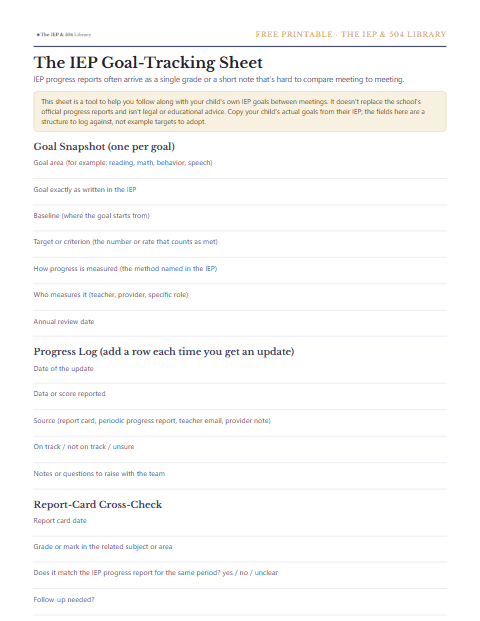
Get the free IEP Goal-Tracking Sheet (PDF)
One page per goal to log the baseline, the target and every progress update, so you see a pattern across the year.
We email you the PDF, plus a note if the guidance on this topic changes. Unsubscribe anytime.