IEP Behavior and Self-Regulation Goals
What are IEP behavior and self-regulation goals?
Behavior and self-regulation IEP goals help a child build the skills to notice big feelings, stay with a task and use calming or coping strategies at school. A well-written behavior goal names a positive skill to grow, a baseline, a measurable target and a way to measure it, so progress is something the team can see rather than guess. When a child's behavior gets in the way of learning, IDEA directs the team to consider positive behavioral interventions and supports, which is why strong goals build a skill instead of only naming a behavior to stop. The examples below are starting points to shape with your child's team, not goals to copy.
What a measurable behavior and self-regulation goal looks like
A measurable annual behavior goal names the skill, the condition, the criterion and how it is measured. IDEA requires annual goals to be measurable (34 CFR 300.320(a)(2)) and treats behavior and self-regulation goals as functional goals, so a goal like 'will show better self-control' is not enough. A strong goal names an observable behavior and a number, such as using a calming strategy on 4 of 5 occasions or staying on task for 10 minutes. It also names the positive behavior the child is learning rather than only the behavior to reduce.
Example goals by grade band
Each goal below is an example to discuss and adapt with your team, never a target your child must meet. The specific rates and percentages are illustrations of what a measurable goal looks like. To see how the parts fit together, try the goal practice builder.
Lower elementary (K-2)
Example · Self-regulation and calming strategies
Given a visual choice of calming strategies when [student] notices a strong feeling, [student] will choose and use one strategy from the card, such as taking deep breaths or asking for a short break, then return to the activity within 5 minutes on 4 of 5 observed occasions by the annual review date, as measured by teacher observation records.
What to ask your team: Ask which calming strategies your child already responds to at home so the choices on the card match what works for them.
Example · Following classroom routines
Given a picture schedule and one reminder, [student] will begin an assigned task within 2 minutes and stay with it for 10 minutes on 4 of 5 opportunities by the annual review date, as measured by teacher-recorded time-on-task data.
What to ask your team: Ask what supports, like the picture schedule, help your child start a task so the goal builds on them.
Upper elementary (3-5)
Example · Impulse control and self-monitoring
Given a self-monitoring checklist during class discussion, [student] will raise a hand and wait to be called on before speaking on 8 of 10 opportunities across two weeks by the annual review date, as measured by a self-monitoring checklist reviewed with the teacher.
What to ask your team: Ask how the checklist is introduced so your child sees it as a support they own, not a report card.
Example · Frustration tolerance
When faced with a difficult task, [student] will use a taught coping strategy, such as asking for help, taking a short break or using positive self-talk, to keep working on 4 of 5 observed occasions by the annual review date, as measured by teacher observation and a shared coping-strategy log.
What to ask your team: Ask which coping strategies your child has been taught so the goal names ones they have actually practiced.
Middle school (6-8)
Example · Recognizing and managing feelings
Given instruction in noticing early signs of frustration, [student] will name the feeling and choose a regulation strategy before a situation escalates on 4 of 5 observed occasions across a grading period by the annual review date, as measured by teacher and student check-in records.
What to ask your team: Ask how the check-ins happen during the day so they fit your child's schedule and feel private.
Example · Task initiation and work completion
Given a written checklist and a timer, [student] will start assigned classwork within 5 minutes and turn in completed work for 80 percent of assignments across a grading period by the annual review date, as measured by a work-completion log.
What to ask your team: Ask what gets in the way of starting work for your child so the plan targets the real sticking point.
High school (9-12)
Example · Self-regulation and using a break
When [student] feels overwhelmed in class, [student] will use a pre-arranged break or self-regulation strategy and return to the task within 10 minutes on 4 of 5 observed occasions across a grading period by the annual review date, as measured by teacher observation and student self-report.
What to ask your team: Ask how your child can signal for the break discreetly so using it does not draw attention.
Example · Self-management and progress tracking
Given a self-management plan, [student] will track a chosen self-regulation behavior each day and meet the agreed target on 80 percent of school days across a grading period by the annual review date, as measured by the student's own data chart reviewed weekly with a staff member.
What to ask your team: Ask whether your child helped choose the behavior to track so the plan builds their ownership and self-advocacy.
What makes a goal measurable
- Names an observable, measurable behavior with a rate, a percentage or a count, not a vague trait like 'will behave better'
- Names a positive skill for the child to build, such as a coping or self-regulation strategy, not only a behavior to stop
- States how progress is measured and how often, such as observation records, a self-monitoring checklist or time-on-task data
- Is written in person-first, respectful language that describes the behavior, never the child
- Is a starting point to shape with the team, never a fixed prescription
Common mistakes to watch for
- A goal aimed only at reducing a behavior, with no positive skill named for the child to learn instead
- Vague wording like 'will show self-control' that no one can observe or count
- No baseline, so there is no way to tell whether the behavior is changing
- Deficit-first wording that describes the child by a behavior rather than describing the behavior itself
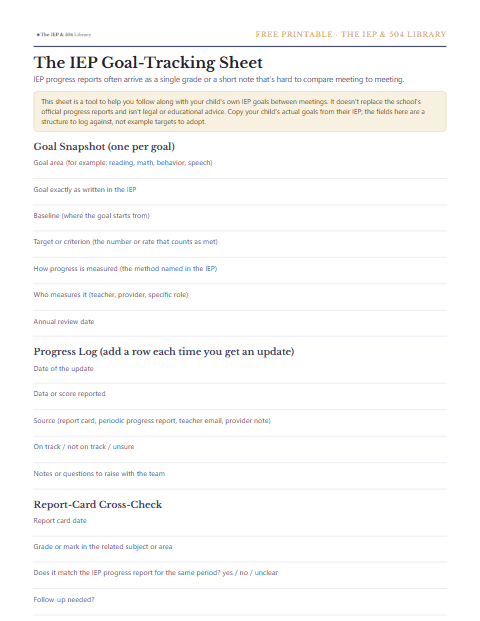
Get the free IEP Goal-Tracking Sheet (PDF)
One page per goal to log the baseline, the target and every progress update, so you see a pattern across the year.
We email you the PDF, plus a note if the guidance on this topic changes. Unsubscribe anytime.