IEP Communication and Speech-Language Goals
What are IEP communication and speech-language goals?
IEP communication goals usually cover two areas: expressive language (how a child puts thoughts into words, sentences and stories) and receptive language (how a child understands what is said, from following directions to answering questions). A well-written communication goal names a baseline, a measurable target and a way to measure it, so progress is something the team can see rather than guess. The examples below are starting points to shape with your child's speech-language pathologist and the rest of the team, not goals to copy. Speech-sound and articulation goals are a separate area a speech-language pathologist addresses directly, so this page focuses on the language goals parents most often prepare for.
What a measurable communication and speech-language goal looks like
A measurable annual communication goal names the skill, the condition, the criterion and how it is measured. IDEA requires annual goals to be measurable (34 CFR 300.320(a)(2)), so a goal like 'will improve communication' is not enough; a goal names a percentage, a rate, a number of steps or a rubric score the team can track. IDEA also directs the IEP team to consider a child's communication needs (34 CFR 300.324(a)(2)(iv)). When speech-language services are part of the plan they are a related service under IDEA (34 CFR 300.34(c)(15)), so a speech-language pathologist usually drafts these goals and helps the team measure them.
Example goals by grade band
Each goal below is an example to discuss and adapt with your team, never a target your child must meet. The specific rates and percentages are illustrations of what a measurable goal looks like. To see how the parts fit together, try the goal practice builder.
Lower elementary (K-2)
Example · Receptive language: following directions
Given a two-step direction with an unrelated pair of actions (for example, 'Put your book away and line up at the door'), [student] will carry out both steps in the correct order on 4 of 5 opportunities across three consecutive sessions by the annual review date, as measured by therapist data collection during structured classroom routines.
What to ask your team: Ask what the current baseline is (how many steps [student] follows now) and whether the direction should include a visual or a gesture cue at first.
Example · Expressive language: building complete sentences
Given a picture prompt and a sentence starter, [student] will produce a grammatically complete sentence of at least four words to describe the picture on 8 of 10 trials across three sessions by the annual review date, as measured by a language sample scored by the speech-language pathologist.
What to ask your team: Ask how the team will fade the sentence starter over the year and what counts as a complete sentence for scoring.
Upper elementary (3-5)
Example · Expressive language: retelling and narrative
Given a short story read aloud, [student] will retell the story including the character, the setting, the problem and the resolution in the correct sequence on 4 of 5 retells by the annual review date, as measured by a story-retell rubric scored by the speech-language pathologist.
What to ask your team: Ask whether the story length matches [student]'s instructional level and whether a story map is allowed as a support at first.
Example · Receptive language: answering comprehension questions
Given a grade-level passage read aloud, [student] will answer literal who, what, where and when questions with 80 percent accuracy across three consecutive data sessions by the annual review date, as measured by therapist-recorded comprehension probes.
What to ask your team: Ask what data the school collects between meetings and whether the passages come from the classroom curriculum.
Middle school (6-8)
Example · Expressive language: organized oral explanation
Given a curriculum topic, [student] will give a two- to three-sentence oral explanation that states a main idea and one supporting detail on 4 of 5 opportunities across three sessions by the annual review date, as measured by a rubric scored by the speech-language pathologist.
What to ask your team: Ask what supports help [student] organize the explanation and how the team plans to build toward longer summaries.
Example · Receptive language: understanding figurative language
Given a short passage containing an idiom or figurative expression, [student] will explain its intended meaning using context clues with 80 percent accuracy across three consecutive sessions by the annual review date, as measured by therapist-recorded probes.
What to ask your team: Ask whether the examples come from texts [student] reads in class and how the team will build from single sentences to longer passages.
High school (9-12)
Example · Expressive language: stating a request or question in the moment
Given a classroom or workplace scenario, [student] will state a request or ask a clarifying question in a complete, organized sentence on 4 of 5 role-play opportunities across three sessions by the annual review date, as measured by a rubric scored by the speech-language pathologist.
What to ask your team: Ask how this goal connects to [student]'s transition plan and what real settings the skill will be practiced in.
Example · Receptive language: following multi-step task directions
Given a three- to four-step set of oral directions for an academic or vocational task, [student] will complete all steps in order on 4 of 5 opportunities across three sessions by the annual review date, as measured by therapist and teacher data.
What to ask your team: Ask whether the directions match the tasks [student] meets in class or on the job and what cue is allowed if a step is missed.
What makes a goal measurable
- Names a measurable criterion (a percentage, a rate, a count of steps or a rubric score), not just 'will improve'
- States how progress is measured and how often
- Names the condition or support the skill is measured under (a picture prompt, a sentence starter, a passage read aloud)
- Is written in person-first language that describes the child, never a label
- Is a starting point for the team and the speech-language pathologist, never a fixed prescription
Common mistakes to watch for
- A goal with no baseline, so there is no way to judge progress
- A vague target like 'will communicate better' that names no criterion and no measurement method
- The same goal copied across years with no change in the target
- Deficit-first wording that describes the child by what they cannot do rather than the skill being built
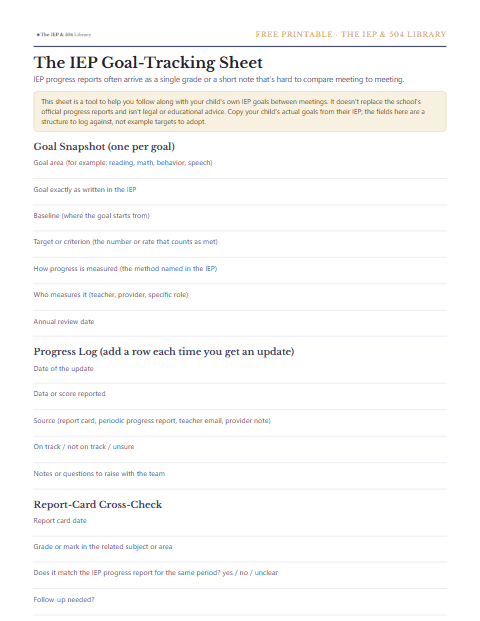
Get the free IEP Goal-Tracking Sheet (PDF)
One page per goal to log the baseline, the target and every progress update, so you see a pattern across the year.
We email you the PDF, plus a note if the guidance on this topic changes. Unsubscribe anytime.