IEP Goals for ADHD
What IEP goals connect to ADHD?
IEP goals connected to ADHD usually target three areas that show up at school: attention and focus, executive functioning (planning, starting tasks, organizing materials and managing time) and behavior and self-regulation. A student with ADHD may be served through an IEP when the team finds specialized instruction is needed, often under the eligibility category called Other Health Impairment, or through a Section 504 plan when accommodations alone give fair access. Either way, a strong goal names a baseline, a measurable target and a way to measure it, so progress is something the team can see rather than guess. The examples below are starting points to shape with your child's team, not goals to copy.
What a measurable ADHD goal looks like
A measurable annual goal names the skill, the condition, the criterion and how it is measured. IDEA requires every annual goal in an IEP to be measurable (34 CFR 300.320(a)(2)), so a goal like 'will pay better attention' is not enough. A measurable ADHD-related goal names an observable behavior, a number to hit (a percentage, a count, a rate or a number of minutes) and how often the school will collect the data. Because ADHD affects attention and executive functioning across the school day, these goals lean on observable classroom behaviors rather than a single test score.
Example goals by grade band
Each goal below is an example to discuss and adapt with your team, never a target your child must meet. The specific rates and percentages are illustrations of what a measurable goal looks like. To see how the parts fit together, try the goal practice builder.
Lower elementary (K-2)
Example · Attention and focus
Given a teacher cue and a 10-minute independent task, [student] will stay engaged with the task, working on the assigned materials, for at least 8 of the 10 minutes on 4 of 5 observed sessions by the annual review date, as measured by teacher time-sampling records.
What to ask your team: Ask what on-task looks like in your child's classroom and what the current baseline number of minutes is.
Example · Task initiation and materials
Given a visual step-by-step checklist, [student] will gather the materials needed to begin an assigned task within 2 minutes of the direction on 4 of 5 trials by the annual review date, as measured by teacher observation logs.
What to ask your team: Ask whether a visual checklist is already in use and what starting point the goal is measured from.
Example · Self-regulation
Given a taught calm-down strategy and a visual reminder, [student] will use the strategy to return to the activity within 5 minutes of becoming frustrated on 4 of 5 observed occasions by the annual review date, as measured by teacher-recorded behavior logs.
What to ask your team: Ask which calm-down strategy the school will teach and how they will track its use.
Upper elementary (3-5)
Example · Self-monitored attention
Given a written assignment and a self-monitoring checklist, [student] will redirect back to the task after a distraction, without an adult prompt, on 4 of 5 observed opportunities by the annual review date, as measured by teacher observation and the student's self-monitoring record.
What to ask your team: Ask how the school will teach self-monitoring so your child can use it independently.
Example · Organization and homework routines
Given a daily planner and a folder checklist, [student] will record each homework assignment and place completed work in the correct folder on 4 of 5 school days across two consecutive weeks by the annual review date, as measured by planner and folder checks.
What to ask your team: Ask who checks the planner each day and how the result is shared with you.
Middle school (6-8)
Example · Time management and multi-step tasks
Given a multi-step assignment broken into a checklist with checkpoint dates, [student] will complete each step by its checkpoint date on 4 of 5 assignments across a grading period by the annual review date, as measured by a shared assignment tracker.
What to ask your team: Ask how long-term assignments get broken into steps and who helps set the checkpoint dates.
Example · Sustained attention in class
Given a note-taking template, [student] will record at least 3 key points during each class period on 4 of 5 monitored lessons by the annual review date, as measured by a review of the student's notes.
What to ask your team: Ask whether the note-taking support matches the way your child learns best.
High school (9-12)
Example · Independent planning and self-advocacy
Given a weekly planning routine and a checklist, [student] will break each long-term assignment into steps with due dates and log progress on 4 of 5 assignments per grading period by the annual review date, as measured by the planner and teacher check-ins.
What to ask your team: Ask how the school will help your child move from prompted planning to doing it independently.
Example · Self-regulation and coping
Given a taught self-regulation strategy, [student] will notice rising frustration and apply the strategy to stay in class on 4 of 5 observed occasions by the annual review date, as measured by student self-report and teacher observation.
What to ask your team: Ask how success is defined here so it centers your child's own coping, not just compliance.
What makes a goal measurable
- Names a measurable criterion (a percentage, a count, a rate or a number of minutes), not just 'will improve focus'
- States how progress is measured and how often the data is collected
- Describes an observable behavior anyone in the room could see and count
- Is written in respectful language that matches how the student and family describe ADHD, person-first or identity-first
- Is a starting point for the team to adapt, never a fixed prescription
Common mistakes to watch for
- A goal with no baseline, so there is no way to judge whether attention or organization improved
- A vague target such as 'will stay on task' with no number and no way to measure it
- Deficit-first wording that describes the child by what they cannot do rather than the skill they are building
- Copying an accommodation such as extended time or a quiet space into the goals section; accommodations and goals are different parts of the plan
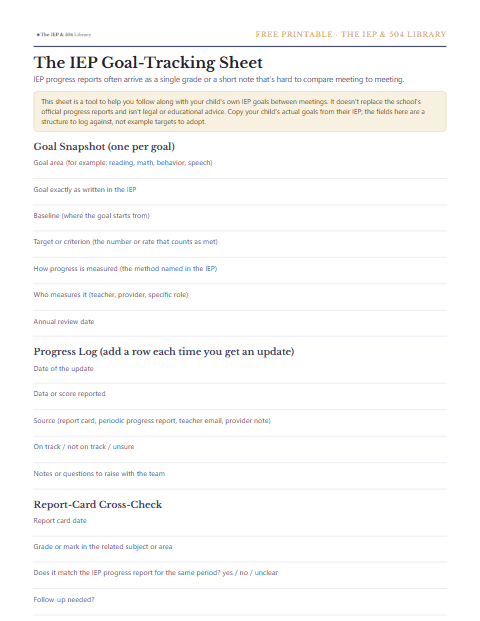
Get the free IEP Goal-Tracking Sheet (PDF)
One page per goal to log the baseline, the target and every progress update, so you see a pattern across the year.
We email you the PDF, plus a note if the guidance on this topic changes. Unsubscribe anytime.