IEP Executive Functioning and Organization Goals
What are IEP executive functioning and organization goals?
IEP executive functioning goals target the organizing skills a student uses to get work done: starting a task, keeping materials in order, managing time, planning multi-step work, holding directions in mind and checking their own work. A well-written executive functioning goal names a baseline, a measurable target and a way to measure it, so progress is something the team can see rather than guess. The examples below are starting points to shape with your child's team, not goals to copy.
What a measurable executive functioning and organization goal looks like
A measurable executive functioning goal names the skill, the condition, the criterion and how it is measured. IDEA requires annual goals to be measurable and lists functional goals alongside academic ones (34 CFR 300.320(a)(2)). The IEP must also state how progress toward each goal will be measured (34 CFR 300.320(a)(3)). So a goal like 'will get more organized' is not enough; a strong goal names a count, a percentage or a ratio of opportunities together with the record the team will keep, such as a planner check or a routine checklist.
Example goals by grade band
Each goal below is an example to discuss and adapt with your team, never a target your child must meet. The specific rates and percentages are illustrations of what a measurable goal looks like. To see how the parts fit together, try the goal practice builder.
Lower elementary (K-2)
Example · Organization of materials
Given a visual checklist and a daily routine, [student] will independently put personal materials in the correct place (backpack, cubby and take-home folder) in 4 of 5 daily opportunities across two weeks by the annual review date, as measured by a teacher-kept routine checklist.
What to ask your team: Ask what visual supports the classroom already uses and how the baseline was set.
Example · Following multi-step directions
Given a two-step direction paired with a visual cue, [student] will start the first step within one minute and complete both steps in 4 of 5 opportunities by the annual review date, as measured by teacher observation records.
What to ask your team: Ask whether directions are paired with a visual and how the one-minute start will be timed.
Upper elementary (3-5)
Example · Task initiation
Given an independent assignment and a printed start-up checklist, [student] will begin working within two minutes of the direction in 4 of 5 observed work periods by the annual review date, as measured by teacher-recorded time-to-start data.
What to ask your team: Ask what counts as beginning work and how often the data will be collected.
Example · Assignment tracking
Given a daily planner and an end-of-class prompt, [student] will record each assignment and its due date for 4 of 5 school days per week across one month by the annual review date, as measured by a weekly planner check.
What to ask your team: Ask who will run the planner check and how the prompt is faded over time.
Middle school (6-8)
Example · Planning and prioritizing
Given a multi-step assignment and a planning organizer, [student] will break the assignment into steps with a target date for each step in 3 of 4 assignments by the annual review date, as measured by a review of the completed organizers.
What to ask your team: Ask whether the organizer is provided every time or gradually faded across the year.
Example · Organization of materials
Given a binder-and-folder system and a weekly sorting routine, [student] will keep materials organized so a requested item is found within one minute in 4 of 5 weekly checks by the annual review date, as measured by a weekly organization rubric.
What to ask your team: Ask what the rubric scores and whether it includes digital files as well as paper.
High school (9-12)
Example · Time management
Given a long-term assignment and a backward-planning template, [student] will set interim deadlines and meet them for 3 of 4 major assignments per grading period by the annual review date, as measured by a teacher-kept deadline log.
What to ask your team: Ask how interim deadlines are set and what support is offered if one is missed.
Example · Self-monitoring
Given a rubric or an assignment checklist, [student] will self-check completed work and flag or fix any missing parts before submitting in 4 of 5 assignments by the annual review date, as measured by a comparison of the student's self-check against the teacher's review.
What to ask your team: Ask how self-monitoring will be taught and practiced before it is measured.
What makes a goal measurable
- Names a measurable criterion (a count, a percentage or a ratio of opportunities), not just 'will improve'
- States how progress is measured and how often
- Names the support or condition the student is given, such as a checklist, a planner or a visual cue
- Is written in person-first language
- Is a starting point for the team, never a fixed prescription
Common mistakes to watch for
- A goal with no baseline, so there is no way to judge progress
- A vague target like 'will be more organized' that names no count and no way to measure it
- The same goal copied from year to year with no change in the target or the support
- Deficit-first wording that describes the child by what they cannot do
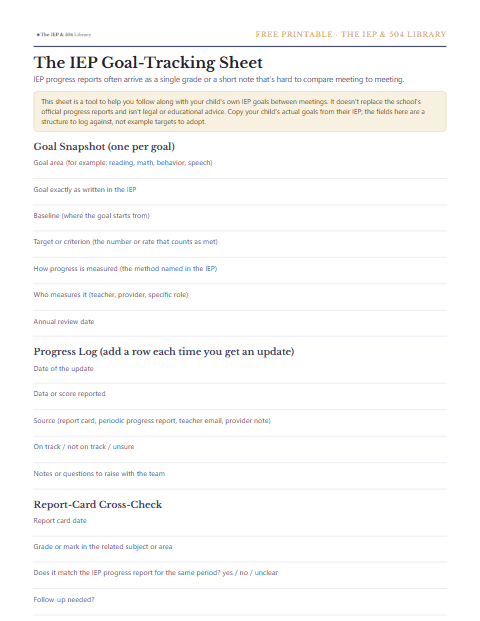
Get the free IEP Goal-Tracking Sheet (PDF)
One page per goal to log the baseline, the target and every progress update, so you see a pattern across the year.
We email you the PDF, plus a note if the guidance on this topic changes. Unsubscribe anytime.