How to Request a 504 Plan
To request a 504 plan, put your request in writing to your child's school, usually the 504 coordinator, the principal or the school counselor, then ask the school to evaluate your child for a 504 plan. The school then gathers information and a group of people who know your child decides whether the child has a disability that substantially limits a major life activity, which is the test for a 504 plan under Section 504. If your child qualifies, the team writes the plan with the accommodations. A written request dates the process and gives you a record, so it is the cleanest way to start.
When to request a 504 plan
Request a 504 plan when a diagnosed or suspected condition is getting in the way of your child's learning, health or access at school and simple classroom adjustments are not enough.
A 504 plan fits a child whose condition substantially limits a major life activity such as learning, reading, concentrating, walking or caring for oneself, but who can make progress in the general classroom with the right supports. Common triggers parents notice are grades slipping despite effort, a new medical diagnosis that needs accommodations like a blood-sugar check or a bathroom pass, anxiety or attention that derails the school day or a physical condition that affects getting around the building.
There is no wrong time to ask. You can request a 504 evaluation at any point in the year, not only at the start. If you are unsure whether your child needs a 504 plan or the more involved supports of an IEP, ask the school to evaluate and let the team weigh it from the evaluation. The section below on choosing between the two explains the difference.
How to request a 504 plan, step by step
Write to the school, name the concern and the condition, ask for a 504 evaluation and keep a copy.
Put the request in writing. Email or a dated letter to the 504 coordinator, the principal or the school counselor is best, because it starts a record. A phone call or a hallway conversation can get lost, so follow any spoken request up in writing the same day.
Name the concern plainly. Say what you are seeing (for example, that your child's asthma, ADHD or anxiety is affecting the school day) and ask the school to evaluate your child for a 504 plan. You do not need legal language. A clear paragraph is enough.
Share what you have. Attach or offer any diagnosis, doctor's note or outside evaluation you want the school to consider. A diagnosis can help but is not always required, because the team decides eligibility from the whole picture of how the condition affects your child at school.
Keep a copy and note the date. The date matters if you ever need to show when you asked. Save your request and any reply in one place, such as an IEP and 504 binder, so your paperwork stays in order.
What happens after you ask
The school gathers information, a knowledgeable group decides eligibility and, if your child qualifies, the team writes the plan.
Once you ask, the school evaluates your child by drawing on the information it already has and any it needs to gather: grades, test data, teacher observations, attendance and health records and anything you share. Section 504 calls for the eligibility decision to be made by a group of people who know the child, the evaluation data and the placement options, rather than one person deciding alone (34 CFR 104.35).
Section 504 does not set a single national deadline the way IDEA sets 60 days for an initial IEP evaluation. It calls for the school to act within a reasonable time. If weeks pass with no response, it is fair to follow up in writing and ask where the request stands. Ask your district what its own timeline is, because many districts publish one.
If the group finds that your child has a disability that substantially limits a major life activity, the team develops the 504 plan: the accommodations, who is responsible for each one and how and when the plan is reviewed. You are part of that conversation. Bring the accommodations you think would help as a starting point for the team to consider.
If the school says no
You have procedural safeguards under Section 504, including notice and the right to an impartial hearing.
A school can decide your child is not eligible, but it cannot simply ignore the request. Section 504 gives you procedural safeguards: notice of decisions about identification and placement, a chance to review the records and the right to an impartial hearing if you disagree (34 CFR 104.36).
If you disagree with the outcome, ask for the reason in writing, request any records the decision relied on and ask the school about its Section 504 hearing process or its 504 coordinator. You can also file a complaint with the U.S. Department of Education's Office for Civil Rights, which enforces Section 504. For a contested situation, a special education advocate or an attorney who works in your state is the right person to bring in.
504 plan or IEP: which to ask for
Ask for a 504 plan when accommodations are enough. Ask for an IEP evaluation when your child needs specially designed instruction.
A 504 plan provides accommodations that change how your child accesses the same instruction, such as extended time, preferential seating or a break pass. An IEP provides specially designed instruction and measurable annual goals for a child who needs the teaching itself changed, not only the conditions around it.
If you think your child needs specialized instruction and goals rather than accommodations alone, you can request an IEP evaluation instead, which runs under IDEA with its own timelines. Our IEP vs 504 guide lays out the difference. Our guide on requesting an IEP evaluation walks that separate process.
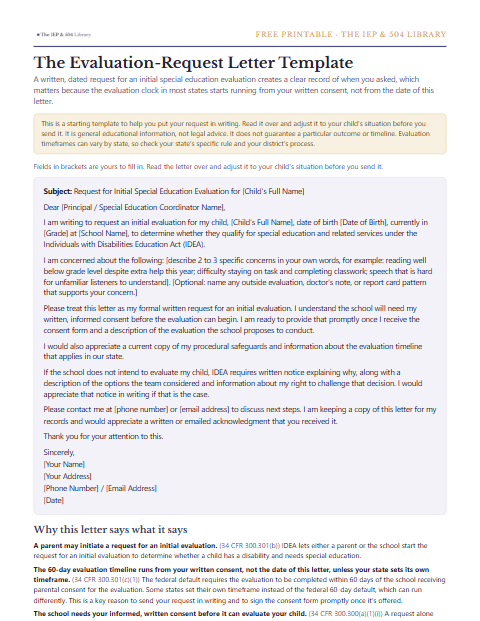
Get the free Evaluation-Request Letter Template (PDF)
A ready-to-adapt letter to request an evaluation in writing, with the dates that matter and the language to use.
We email you the PDF, plus a note if the guidance on this topic changes. Unsubscribe anytime.