IEP Goals for Dyslexia
What IEP goals connect to Dyslexia?
IEP goals for a child with dyslexia focus on reading: the sound skills underneath reading (phonological awareness), decoding and word recognition, spelling, reading fluency and comprehension. Dyslexia is named in federal law as a specific learning disability, so a child can have measurable reading goals written into an IEP. A well-written dyslexia goal names a baseline, a measurable target and a way to measure it, so progress is something the team can see rather than guess. The examples below are starting points to shape with your child's team, not goals to copy.
What a measurable Dyslexia goal looks like
A measurable annual reading goal names the skill, the condition it is measured under, the criterion and how it is measured. IDEA requires annual goals to be measurable (34 CFR 300.320(a)(2)), so a goal like 'will become a better reader' is not enough. For dyslexia the target is usually concrete: a decoding accuracy percentage, words correct per minute or a comprehension-question rate, tied to the reading skill the evaluation flagged. Reading instruction that is explicit and taught in a planned, step-by-step order is what the reading research points to, so it is fair to ask how a goal will be taught, not only what it targets.
Example goals by grade band
Each goal below is an example to discuss and adapt with your team, never a target your child must meet. The specific rates and percentages are illustrations of what a measurable goal looks like. To see how the parts fit together, try the goal practice builder.
Lower elementary (K-2)
Example · Phonological awareness
Given a spoken single-syllable word, [student] will orally segment it into its separate sounds and blend separate sounds back into a word with 90 percent accuracy on 4 of 5 trials by the annual review date, as measured by teacher-recorded phonological-awareness probes.
What to ask your team: Ask which sound skills the baseline shows are already secure, so the goal targets the next step and not one your child has already mastered.
Example · Phonics and decoding
Given a list of grade-level words with short vowels and consonant blends, [student] will read them aloud with 90 percent accuracy on 4 of 5 trials by the annual review date, as measured by teacher-recorded decoding probes.
What to ask your team: Ask what reading method the school will use to teach these patterns and whether it builds skills in a planned, step-by-step order.
Upper elementary (3-5)
Example · Multisyllabic decoding
Given a list of grade-level multisyllabic words, [student] will decode them using taught syllable-division patterns with 85 percent accuracy on 4 of 5 trials by the annual review date, as measured by curriculum-based decoding probes.
What to ask your team: Ask how this goal connects to the words your child meets in class, so the practice transfers to real schoolwork.
Example · Spelling and encoding
Given a list of words that follow taught spelling patterns, [student] will spell them correctly with 80 percent accuracy on 4 of 5 trials by the annual review date, as measured by teacher-recorded spelling probes.
What to ask your team: Ask whether reading and spelling are taught together, since the same sound and letter patterns support both.
Middle school (6-8)
Example · Reading fluency
Given a grade-level passage at the instructional level, [student] will read aloud at 120 words correct per minute with no more than 5 errors on 4 of 5 trials by the annual review date, as measured by curriculum-based oral reading fluency probes.
What to ask your team: Ask whether the passage level matches your child's current reading level and how often the probe is run, so the rate is measured fairly.
Example · Reading comprehension
Given a grade-level informational passage read with any supports listed in the IEP, [student] will answer literal and inferential comprehension questions with 80 percent accuracy on 4 of 5 trials by the annual review date, as measured by curriculum-based comprehension assessments.
What to ask your team: Ask whether comprehension is measured with the reading supports your child actually uses, so the score reflects real classroom conditions.
High school (9-12)
Example · Comprehension with strategy use
Given a grade-level text and a taught comprehension strategy such as summarizing or question-generation, [student] will identify the main idea and two supporting details with 80 percent accuracy across 4 of 5 assignments by the annual review date, as measured by scored classroom assignments using a shared rubric.
What to ask your team: Ask how progress will be tracked across real assignments and not only on a separate test, so the goal reflects daily coursework.
Example · Self-advocacy and assistive technology
Given a classroom task where a support would help, [student] will independently choose and use an appropriate tool such as text-to-speech or extended time in 4 of 5 observed opportunities by the annual review date, as measured by a teacher-kept observation log.
What to ask your team: Ask how the team will help your teen practice asking for supports, since self-advocacy matters more as school gets less hands-on.
What makes a goal measurable
- Names a measurable criterion such as a percentage, a rate (words correct per minute) or a count, not just 'will improve'
- Targets a specific reading skill the evaluation identified, from sound awareness and decoding through fluency and comprehension
- States how progress is measured and how often
- Is written in person-first language about the child, never defined by the label
- Is a starting point for the team to shape, never a fixed prescription
Common mistakes to watch for
- A goal with no baseline, so there is no way to judge whether reading is improving
- A vague target like 'will read at grade level' with no accuracy percentage, rate or comprehension measure
- The same goal copied from year to year with no change in the target
- Deficit-first wording that describes the child by what they cannot do rather than the skill being built
- A goal that names only accommodations such as extra time or audiobooks but no skill target, when the child also needs reading skills taught
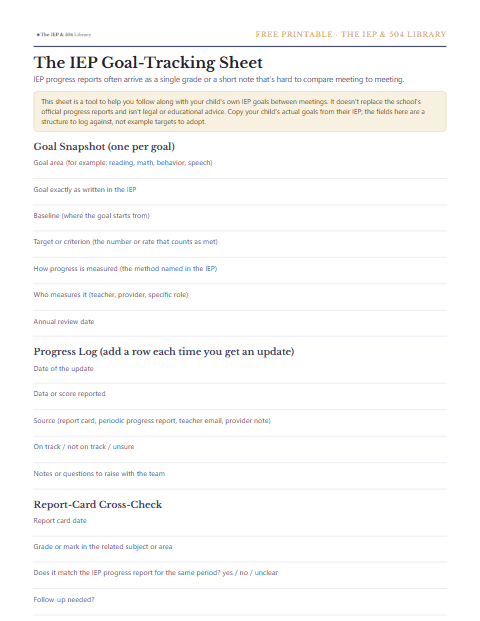
Get the free IEP Goal-Tracking Sheet (PDF)
One page per goal to log the baseline, the target and every progress update, so you see a pattern across the year.
We email you the PDF, plus a note if the guidance on this topic changes. Unsubscribe anytime.