IEP Fine Motor and Handwriting Goals
What are IEP fine motor and handwriting goals?
IEP fine motor and handwriting goals usually cover a few areas: handwriting legibility (letter formation, spacing and sizing), the hand skills behind writing such as grasp, scissor use and managing small classroom tools, plus keyboarding as another way to get words onto the page. Fine motor support often brings the occupational therapist into the conversation. The OT is part of the team. A well-written goal names a baseline, a measurable target and a way to measure it, so progress is something the team can see rather than guess. The examples below are starting points to shape with your child's team, including the OT, not goals to copy.
What a measurable fine motor and handwriting goal looks like
A measurable annual goal names the skill, the condition, the criterion and how it is measured. IDEA requires annual goals to be measurable (34 CFR 300.320(a)(2)), so a goal like 'will improve handwriting' is not enough. A stronger goal names a legibility percentage, a cutting accuracy or a typing rate a reader can check. Because fine motor sits close to occupational therapy, the team including the OT decides whether a skill belongs in a goal, in related services or in an accommodation.
Example goals by grade band
Each goal below is an example to discuss and adapt with your team, never a target your child must meet. The specific rates and percentages are illustrations of what a measurable goal looks like. To see how the parts fit together, try the goal practice builder.
Early elementary (K-2)
Example · Letter formation
Given a model and primary-lined paper, [student] will form the lowercase letters of their first name using the correct starting point and stroke order on 4 of 5 trials by the annual review date, as measured by teacher-scored handwriting samples.
What to ask your team: Ask what baseline the goal starts from and whether the occupational therapist helped set the target.
Example · Scissor and tool use
Given child-safe scissors and a printed straight line, [student] will cut along the line staying within one-quarter inch of it on 4 of 5 trials by the annual review date, as measured by scored classroom cutting samples.
What to ask your team: Ask how this skill connects to what your child actually does in class, so the goal stays functional rather than a drill for its own sake.
Upper elementary (3-5)
Example · Handwriting legibility
Given a two-sentence writing prompt and single-lined paper, [student] will produce handwriting that a reader who did not watch it being written can read at 90 percent word legibility on 4 of 5 trials by the annual review date, as measured by a legibility check scored by two staff members.
What to ask your team: Ask how legibility is scored and who scores it, so the measure is not one person's opinion.
Example · Keyboarding as an alternative to handwriting
Given a keyboarding program and a short passage to copy, [student] will type at 15 words per minute with 90 percent accuracy on 4 of 5 trials by the annual review date, as measured by the program's recorded typing rate.
What to ask your team: Ask whether keyboarding is meant to sit alongside handwriting or become your child's main way to write, so everyone agrees on the plan.
Middle and high school (6-12)
Example · Functional note-taking
Given a graphic organizer and a five-minute note-taking task, [student] will record legible notes that capture at least 4 key points on 4 of 5 trials by the annual review date, as measured by teacher review of the notes.
What to ask your team: Ask what tools are allowed during the task, since a laptop or a note-taking app may fit your child better than handwriting.
Example · Choosing and using the right writing tool
Given a writing assignment and access to both handwriting and a word processor, [student] will choose and use the tool that fits the task and finish the assignment on 4 of 5 assignments by the annual review date, as measured by a teacher-kept task log.
What to ask your team: Ask how this goal builds your child's independence, so it reads as a skill they own rather than something done to them.
What makes a goal measurable
- Names a measurable criterion (a legibility percentage, a cutting accuracy, a typing rate or a count), not just 'will improve'
- States how progress is measured and how often
- Ties the skill to something the child needs to do in class, so it stays functional rather than only about neatness
- Is written in person-first language
- Is a starting point for the team, including the occupational therapist, never a fixed prescription
Common mistakes to watch for
- A goal with no baseline, so there is no way to judge progress
- A vague target like 'will improve handwriting' with no percentage, rate or count to measure
- Treating neat handwriting as the only acceptable output when keyboarding may serve the child better
- Deficit-first wording that describes the child by what they cannot do
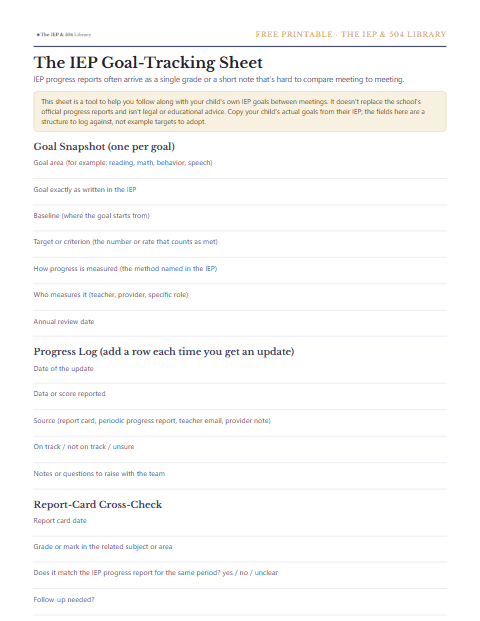
Get the free IEP Goal-Tracking Sheet (PDF)
One page per goal to log the baseline, the target and every progress update, so you see a pattern across the year.
We email you the PDF, plus a note if the guidance on this topic changes. Unsubscribe anytime.