The IEP Goal Bank: Measurable Sample Goals by Area and Grade
What is an IEP goal bank?
An IEP goal bank is a set of sample goals organized by skill area, written to show what a measurable, respectfully worded goal looks like before a meeting. Pick your child's area of need below to see example goals by grade band, what to ask your team about each one and what separates a measurable goal from a vague one. Every example is a starting point to discuss and adapt with your child's team, never a goal to copy or a target your child must meet.
What makes an IEP goal measurable
A measurable annual goal names four things the way IEP goal-writing guides describe them: the condition (what the child is given), the target skill or behavior, the criterion (a rate, a percentage or a count) and the timeframe. IDEA requires annual goals to be measurable (34 CFR 300.320(a)(2)) and requires the IEP to describe how progress is measured and reported (34 CFR 300.320(a)(3)), so "will improve reading" is not enough. A measurable goal names a number and states how progress is checked.
Browse the goal bank by area
Want to see how a measurable goal fits together before you read the examples? The goal practice builder breaks real example goals into their four parts and lets you assemble a practice scaffold to discuss with your team.
Academic skills
IEP Reading Goals
IEP reading goals usually cover three areas: phonics and decoding (sounding out words), fluency (reading smoothly and at a comfortable pace) and comprehension (understanding what was read).
IEP Writing Goals
IEP writing goals usually cover two areas: written expression (putting ideas onto the page in sentences, paragraphs and longer pieces) and spelling.
IEP Math Goals
IEP math goals usually cover two areas: computation (working with numbers and operations, such as math facts, multi-digit problems and fractions) and problem-solving (applying math to word problems and real-world situations, such as deciding which operation a problem calls for).
Communication, behavior and social skills
IEP Communication and Speech-Language Goals
IEP communication goals usually cover two areas: expressive language (how a child puts thoughts into words, sentences and stories) and receptive language (how a child understands what is said, from following directions to answering questions).
IEP Behavior and Self-Regulation Goals
Behavior and self-regulation IEP goals help a child build the skills to notice big feelings, stay with a task and use calming or coping strategies at school.
IEP Social-Emotional and Social Skills Goals
Social-emotional and social-skills IEP goals build the everyday abilities a child uses to recognize feelings, manage strong emotions, get along with peers and take another person's point of view.
Attention, executive function and life skills
IEP Executive Functioning and Organization Goals
IEP executive functioning goals target the organizing skills a student uses to get work done: starting a task, keeping materials in order, managing time, planning multi-step work, holding directions in mind and checking their own work.
IEP Attention and Focus Goals
Attention and focus goals help a student stay engaged with schoolwork: starting tasks, staying on task, finishing work and noticing when their focus has drifted so they can bring it back.
IEP Adaptive and Functional Life Skills Goals
Adaptive and functional goals cover the everyday skills that help a child take part in school and grow more independent.
IEP Fine Motor and Handwriting Goals
IEP fine motor and handwriting goals usually cover a few areas: handwriting legibility (letter formation, spacing and sizing), the hand skills behind writing such as grasp, scissor use and managing small classroom tools, plus keyboarding as another way to get words onto the page.
IEP Transition and Post-Secondary Goals
IEP transition goals plan for life after high school.
By condition
IEP Goals for ADHD
IEP goals connected to ADHD usually target three areas that show up at school: attention and focus, executive functioning (planning, starting tasks, organizing materials and managing time) and behavior and self-regulation.
IEP Goals for Autism
IEP goals for an autistic student most often cross three areas: communication, social connection and self-regulation, alongside any academic goals the evaluation shows are needed.
IEP Goals for Dyslexia
IEP goals for a child with dyslexia focus on reading: the sound skills underneath reading (phonological awareness), decoding and word recognition, spelling, reading fluency and comprehension.
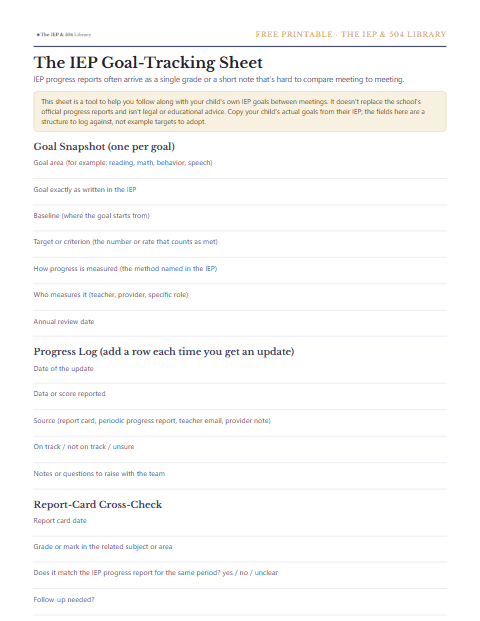
Get the free IEP Goal-Tracking Sheet (PDF)
One page per goal to log the baseline, the target and every progress update, so you see a pattern across the year.
We email you the PDF, plus a note if the guidance on this topic changes. Unsubscribe anytime.